
Hartford COUNTY · Industry & labor
Manchester’s Silk City: The Cheney Mills
Lewis Hine’s 1924 photographs open a window onto the people and machinery behind Manchester’s silk industry and its transformation into a preserved mill district.
Historical focus · 1855–1990s
LOOK CLOSER · OPEN ANY IMAGE
The story in photographs
1924.
Young worker beside a wagon at the Cheney mills
Young worker beside a wagon at the Cheney mills — 1924.
Image credit & source
Hine, Lewis Wickes, 1874-1940 / National Child Labor Committee collection, Library of Congress, Prints and Photographs Division
No known restrictions on publication. For information see: "National Child Labor Committee (Lewis Hine photographs)," https://hdl.loc.gov/loc.pnp/res.097.hine
Original source · Reuse terms1924.
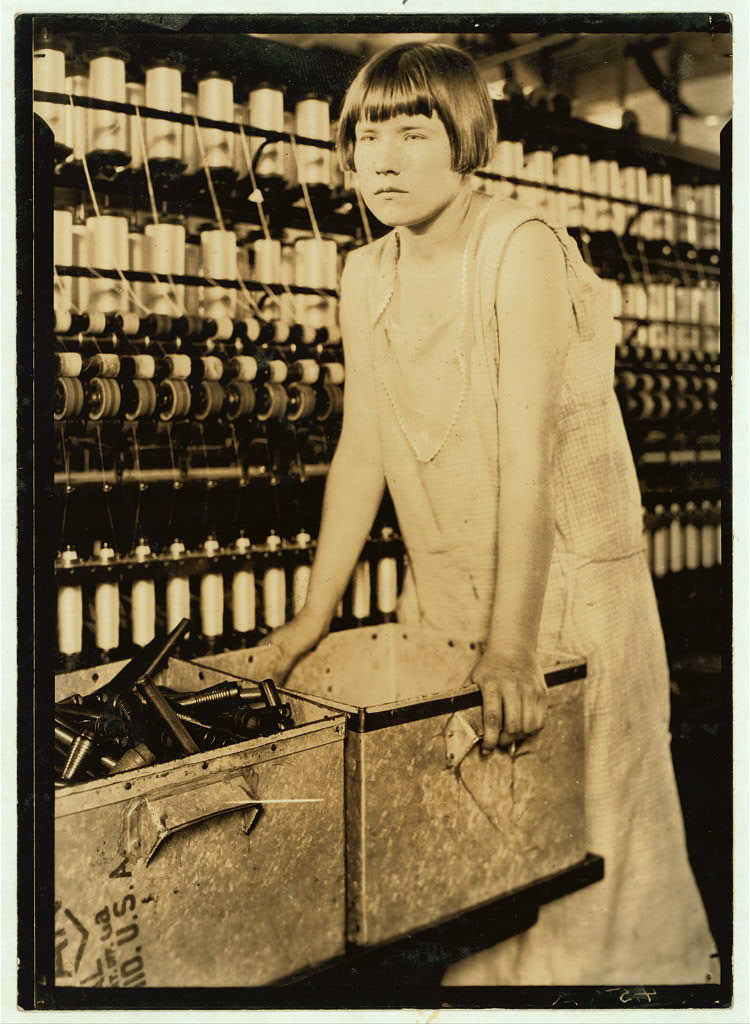
Portrait of a young Cheney mill worker
Portrait of a young Cheney mill worker, Cheney Silk Mills, 1924
Image credit & source
Hine, Lewis Wickes, 1874-1940 / National Child Labor Committee collection, Library of Congress, Prints and Photographs Division
No known restrictions on publication. For information see: "National Child Labor Committee (Lewis Hine photographs)," https://hdl.loc.gov/loc.pnp/res.097.hine
Original source · Reuse terms1924.
Cheney mill workers and machinery, view 3
Cheney mill workers and machinery, view 3 — 1924.
Image credit & source
Hine, Lewis Wickes, 1874-1940 / National Child Labor Committee collection, Library of Congress, Prints and Photographs Division
No known restrictions on publication. For information see: "National Child Labor Committee (Lewis Hine photographs)," https://hdl.loc.gov/loc.pnp/res.097.hine
Original source · Reuse terms1924.
Worker seated at a textile inspection table
Worker seated at a textile inspection table, Cheney Silk Mills, 1924
Image credit & source
Hine, Lewis Wickes, 1874-1940 / National Child Labor Committee collection, Library of Congress, Prints and Photographs Division
No known restrictions on publication. For information see: "National Child Labor Committee (Lewis Hine photographs)," https://hdl.loc.gov/loc.pnp/res.097.hine
Original source · Reuse terms1924.
Worker at a lighted textile inspection table
Worker at a lighted textile inspection table, Cheney Silk Mills, 1924
Image credit & source
Hine, Lewis Wickes, 1874-1940 / National Child Labor Committee collection, Library of Congress, Prints and Photographs Division
No known restrictions on publication. For information see: "National Child Labor Committee (Lewis Hine photographs)," https://hdl.loc.gov/loc.pnp/res.097.hine
Original source · Reuse terms1924.
Portrait at a textile inspection table
Portrait at a textile inspection table, Cheney Silk Mills, 1924
Image credit & source
Hine, Lewis Wickes, 1874-1940 / National Child Labor Committee collection, Library of Congress, Prints and Photographs Division
No known restrictions on publication. For information see: "National Child Labor Committee (Lewis Hine photographs)," https://hdl.loc.gov/loc.pnp/res.097.hine
Original source · Reuse terms1924.
Young worker with spools in the background
Young worker with spools in the background, Cheney Silk Mills, 1924
Image credit & source
Hine, Lewis Wickes, 1874-1940 / National Child Labor Committee collection, Library of Congress, Prints and Photographs Division
No known restrictions on publication. For information see: "National Child Labor Committee (Lewis Hine photographs)," https://hdl.loc.gov/loc.pnp/res.097.hine
Original source · Reuse terms1924.
Examining fabric at a lighted table
Examining fabric at a lighted table, Cheney Silk Mills, 1924
Image credit & source
Hine, Lewis Wickes, 1874-1940 / National Child Labor Committee collection, Library of Congress, Prints and Photographs Division
No known restrictions on publication. For information see: "National Child Labor Committee (Lewis Hine photographs)," https://hdl.loc.gov/loc.pnp/res.097.hine
Original source · Reuse terms1924
Cheney Silk Mills — Hine photograph 2018677841
Cheney Silk Mills — Hine photograph 2018677841
Image credit & source
Hine, Lewis Wickes, 1874-1940 / National Child Labor Committee collection, Library of Congress
No known restrictions on publication. For information see: "National Child Labor Committee (Lewis Hine photographs)," https://hdl.loc.gov/loc.pnp/res.097.hine
Original source · Reuse terms1924
Cheney Silk Mills — Hine photograph 2018677837
Cheney Silk Mills — Hine photograph 2018677837
Image credit & source
Hine, Lewis Wickes, 1874-1940 / National Child Labor Committee collection, Library of Congress
No known restrictions on publication. For information see: "National Child Labor Committee (Lewis Hine photographs)," https://hdl.loc.gov/loc.pnp/res.097.hine
Original source · Reuse terms1924
Cheney Silk Mills — Hine photograph 2018677839
Cheney Silk Mills — Hine photograph 2018677839
Image credit & source
Hine, Lewis Wickes, 1874-1940 / National Child Labor Committee collection, Library of Congress
No known restrictions on publication. For information see: "National Child Labor Committee (Lewis Hine photographs)," https://hdl.loc.gov/loc.pnp/res.097.hine
Original source · Reuse terms1924
Cheney Silk Mills — Hine photograph 2018677835
Cheney Silk Mills — Hine photograph 2018677835
Image credit & source
Hine, Lewis Wickes, 1874-1940 / National Child Labor Committee collection, Library of Congress
No known restrictions on publication. For information see: "National Child Labor Committee (Lewis Hine photographs)," https://hdl.loc.gov/loc.pnp/res.097.hine
Original source · Reuse termsTHE STORY BEHIND THE PHOTOGRAPHS
People, places, and change.
Silk becomes a town-making industry
The Cheney business began before this collection’s main period, but incorporation in 1855 marked a new stage in its growth. The mills helped turn South Manchester into a major textile center, drawing employees from the United States and Europe. Silk manufacture connected the town to supplies and markets far beyond Connecticut. The company’s buildings, housing and institutions made the industry part of residents’ daily surroundings, not simply a place where they worked. [1] [2]
Inside the mills with Lewis Hine
In 1924 Lewis Hine photographed the Cheney mills for the National Child Labor Committee. The Library of Congress preserves a series cataloged under the historical heading “Favorable working conditions.” The images include young workers, machinery and shop-floor spaces. That wording is part of the original documentation, not a blanket judgment by this archive. Hine’s photographs allow readers to examine the working environment closely while remembering that a camera records a selected instant and cannot by itself establish wages, hours or every worker’s experience. [3] [4]
Prosperity, decline and reinvention
By the early 1920s the mills employed about 4,700 people. After the 1923 peak, changing fashions, synthetic fibers and the Depression eroded the silk business. Reorganization in 1935 and wartime production gave the company a further chapter, including nylon parachutes. The Cheney family sold the business to J.P. Stevens in 1955. The last remaining textile operation, the Velvet Mill, closed in 1984. These changes unfolded over decades rather than as a single sudden end. [2]
Preserving an industrial neighborhood
The mill area became a National Historic Landmark District in 1978. During the 1980s and 1990s, many mill buildings were adapted for apartments. Preservation here therefore involved reuse of a large working landscape, not only the protection of one commemorative building. Reading photographs of people and machinery alongside the surviving architecture restores some of the human scale of the district. Its importance lies in the relationship among production, residence, company influence and the workers whose skill made the finished textiles possible. [2] [5] [3]
Sources & further reading (5)
Keep the sources close.
Download this collection’s notes, timeline and image credits. Photographs link to their original archives and require an internet connection.
Building dates and photograph dates are recorded separately. Later photographs are identified in their captions; unknown exposure dates remain unknown. Follow each image’s credit and reuse terms.