
Hartford COUNTY · Industry & labor
Collinsville: Tools, a Company Village and a Museum
Trademark records, company history and a worker’s preservation effort trace the tools and people of Collinsville.
Historical focus · 1850–1970
LOOK CLOSER · OPEN ANY IMAGE
The story in photographs
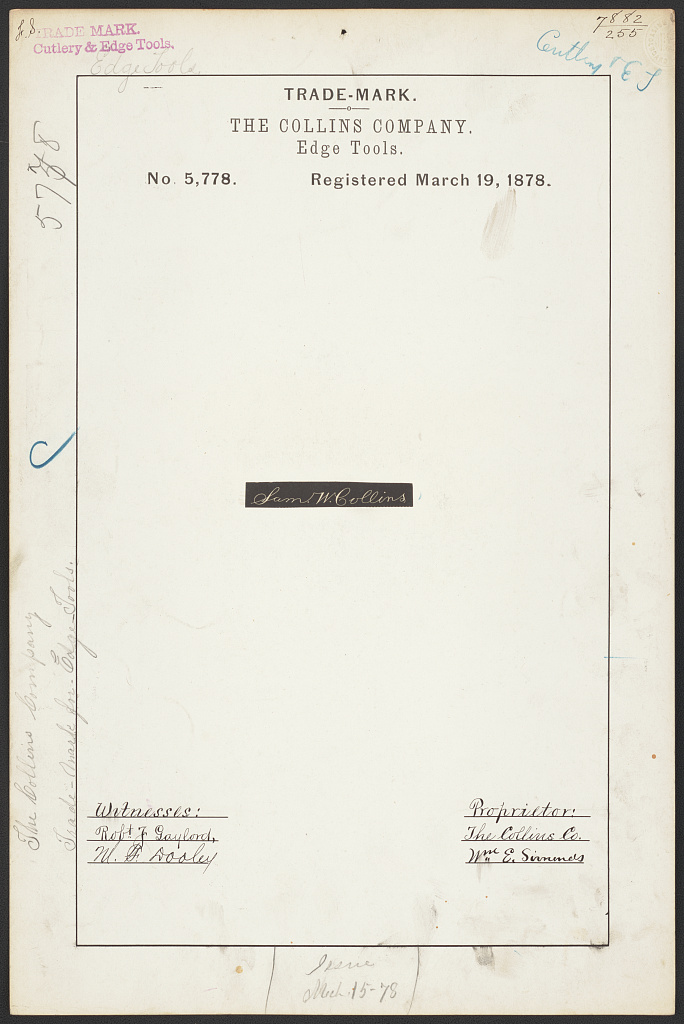
1878 Mar. 19.
Collins edge-tool trademark registration, 1878
Collins edge-tool trademark registration, 1878 — 1878 Mar. 19.
Image credit & source
The Collins Company (registrant; designer not named) / Library of Congress, Prints and Photographs Division
Public domain in the United States: published trademark graphic, 1878 Mar. 19. (copyright term expired).
Original source · Reuse terms1883 Jan. 16.
Collins earth-working-tool trademark registration, 1883
Collins earth-working-tool trademark registration, 1883 — 1883 Jan. 16.
Image credit & source
The Collins Company (registrant; designer not named) / Library of Congress, Prints and Photographs Division
Public domain in the United States: published trademark graphic, 1883 Jan. 16. (copyright term expired).
Original source · Reuse terms1883 Jan. 30.
Collins agricultural-implement trademark registration, 1883
Collins agricultural-implement trademark registration, 1883 — 1883 Jan. 30.
Image credit & source
The Collins Company (registrant; designer not named) / Library of Congress, Prints and Photographs Division
Public domain in the United States: published trademark graphic, 1883 Jan. 30. (copyright term expired).
Original source · Reuse terms1881 Nov. 15
Legitimus edge-tool trademark, 1881
Legitimus edge-tool trademark, 1881
Image credit & source
Creator not identified in the catalog / Library of Congress, Prints and Photographs Division
No known restrictions on publication.
Original source · Reuse termsTHE STORY BEHIND THE PHOTOGRAPHS
People, places, and change.
A village organized around manufacture
The Collins Company began in 1826, and by the middle of the nineteenth century its edge-tool business had become the defining industry of Collinsville, a village within Canton. Axes and other cutting tools linked the factory to distant markets. The village’s buildings, transport connections and everyday institutions grew in relation to that business. County browsing should therefore place Collinsville under Canton while keeping the familiar village name visible. [1] [2]
Branding a physical product
Nineteenth-century trademark registrations in the Library of Congress provide a different kind of visual evidence from a factory photograph. They record the names and marks used to identify edge tools and agricultural implements. The 1878 and 1883 registrations in this collection show how a manufacturer asserted the identity of its products beyond the factory gate. These are documentary graphics, labeled as such, rather than photographs of workers or evidence of a particular workshop process. [5] [6] [7]
A worker begins to save the past
Pattern maker Frederick Robert Widen collected tools, memorabilia and other objects as he watched older material disappear. His collection developed during the 1930s and moved into company-provided space as it grew. This is a preservation story rooted in someone who knew the factory through work. Objects saved from routine disposal later made it possible to interpret the company and the town through tangible evidence. [3]
After the company closed
The Collins Company shut in 1966. Residents concerned about the future of Widen’s collection organized the Canton Historical Society, and the Canton Historical Museum opened publicly in 1970. Closure did not end the community’s relationship with the industrial site. Instead it changed the task from making products to preserving and interpreting a manufacturing past. The museum’s catalogs, tools and local records remain useful starting points for research into the work and lives associated with Collinsville. The gallery presents historic trademark documents, identified as documentary graphics rather than photographs. [3] [4]
Sources & further reading (7)
- Canton Historical Museum: research overview
- Town of Canton: Natural Resource Inventory, historical resources
- Canton Historical Museum: Our History
- Canton Historical Museum: Archives
- Library of Congress: Collins edge-tool trademark, 1878
- Library of Congress: Collins earth-working tools trademark, 1883
- Library of Congress: Collins agricultural implements trademark, 1883
Keep the sources close.
Download this collection’s notes, timeline and image credits. Photographs link to their original archives and require an internet connection.
Building dates and photograph dates are recorded separately. Later photographs are identified in their captions; unknown exposure dates remain unknown. Follow each image’s credit and reuse terms.