
Middlesex COUNTY · Industry & working life
Deep River and Ivoryton: factories and company towns
Piano parts, workers’ housing and the buildings of the lower valley’s ivory industry.
Historical focus · 1850–1999
LOOK CLOSER · OPEN ANY IMAGE
The story in photographs
circa 1911–1915
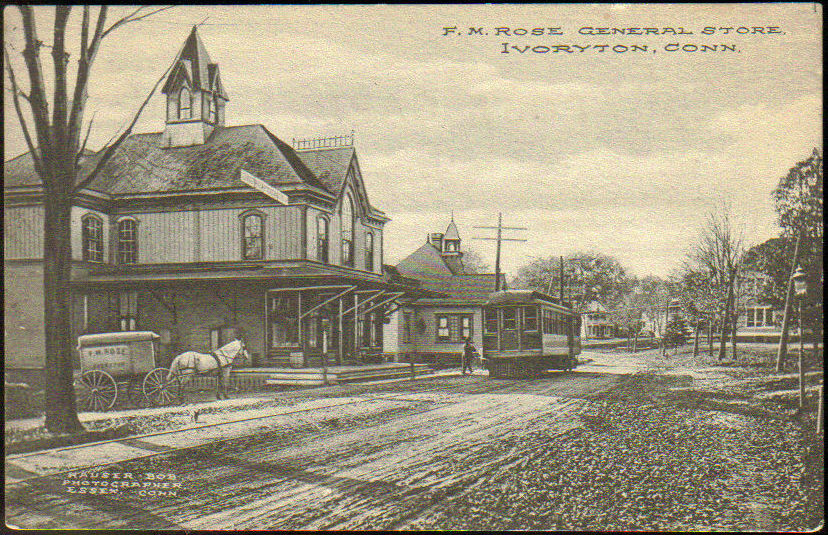
F. M. Rose General Store and a trolley, Ivoryton — historical postcard
F. M. Rose General Store and a trolley, Ivoryton — historical postcard
Image credit & source
Historical postcard / Wikimedia Commons; original creator not identified
Public domain
Original source · Reuse terms
Postmarked 1908
Comstock, Cheney keyboard factory, Ivoryton — postcard postmarked 1908
Comstock, Cheney keyboard factory, Ivoryton — postcard postmarked 1908
Image credit & source
Historical postcard / Wikimedia Commons; original creator not identified
Public domain
Original source · Reuse terms
THE STORY BEHIND THE PHOTOGRAPHS
People, places, and change.
The factory shapes a village
During the nineteenth century, Comstock, Cheney & Company helped build Ivoryton around its ivory and keyboard business. The company’s influence reached housing, shops and community buildings. In 1865 a boarding house was built for male employees; ownership passed to the firm in 1866. Local prosperity depended on a material obtained through the killing of elephants. [1] [3]
Homes, transport and recreation
The Town of Essex documents intensive construction of company housing from 1900 to 1904, including 27 houses in one part of Ivoryton. Postcards show the general store, factory and trolley lines within this working village. Comstock-Cheney Hall opened in 1910 as a recreation building and later became the Ivoryton Playhouse. [2] [1]
A merger in 1936
Comstock, Cheney & Company merged with Pratt, Read & Company of Deep River on December 31, 1936. A separate realty company then handled non-factory property, including workers’ homes. Surviving factories, housing and the Deep River Historical Society’s bleach house allow industrial history to be read at different scales, from a piano component to an entire neighborhood. [2] [3]
Keep the sources close.
Download this collection’s notes, timeline and image credits. Photographs link to their original archives and require an internet connection.
Building dates and photograph dates are recorded separately. Later photographs are identified in their captions; unknown exposure dates remain unknown. Follow each image’s credit and reuse terms.