
Hartford COUNTY · Industry & labor
East Hartford’s Aircraft Engine City
Pratt & Whitney’s expansion appears in photographs of precision production, shift changes and the everyday movement of a wartime workforce.
Historical focus · 1925–1944
LOOK CLOSER · OPEN ANY IMAGE
The story in photographs
1941 May.
Workers leaving the East Hartford aircraft plant
Workers leaving the East Hartford aircraft plant — 1941 May.
Image credit & source
Wolcott, Marion Post, 1910-1990 / Library of Congress, Prints and Photographs Division
No known restrictions. For information, see U.S. Farm Security Administration/Office of War Information Black & White Photographs http://www.loc.gov/rr/print/res/071_fsab.html
Original source · Reuse terms1941 June.
Bridge traffic after an aircraft-plant shift change
Bridge traffic after an aircraft-plant shift change — 1941 June.
Image credit & source
Wolcott, Marion Post, 1910-1990 / Library of Congress, Prints and Photographs Division
No known restrictions. For information, see U.S. Farm Security Administration/Office of War Information Black & White Photographs http://www.loc.gov/rr/print/res/071_fsab.html
Original source · Reuse terms1942 June.
Forgings awaiting precision machining
Forgings awaiting precision machining — 1942 June.
Image credit & source
Feininger, Andreas, 1906-1999 / Library of Congress, Prints and Photographs Division
Public domain; FSA/OWI federal government photograph. Catalog marks unrestricted.
Original source · Reuse terms1942 June.
Lowering an engine power-section assembly
Lowering an engine power-section assembly — 1942 June.
Image credit & source
Feininger, Andreas, 1906-1999 / Library of Congress, Prints and Photographs Division
Public domain; FSA/OWI federal government photograph. Catalog marks unrestricted.
Original source · Reuse terms1942 June.
Installing cylinders on an aircraft engine
Installing cylinders on an aircraft engine — 1942 June.
Image credit & source
Feininger, Andreas, 1906-1999 / Library of Congress, Prints and Photographs Division
Public domain; FSA/OWI federal government photograph. Catalog marks unrestricted.
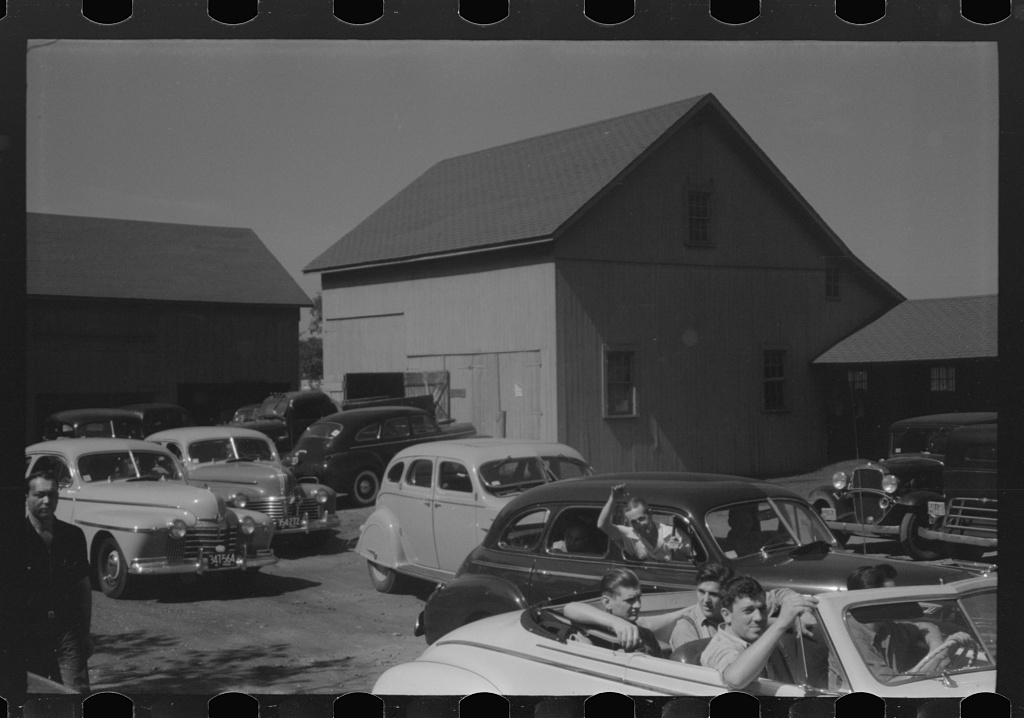
Original source · Reuse terms[1941 May-June]
Buses outside the aircraft plant (attribution tentative in catalog)
Buses outside the aircraft plant (attribution tentative in catalog) — [1941 May-June]
Image credit & source
Wolcott, Marion Post, 1910-1990 / Library of Congress, Prints and Photographs Division
No known restrictions. For information, see U.S. Farm Security Administration/Office of War Information Black & White Photographs http://www.loc.gov/rr/print/res/071_fsab.html
Original source · Reuse terms1941 Sept
Finished propellers. Hamilton propeller plant, East Hartford, Connecticut
Finished propellers. Hamilton propeller plant, East Hartford, Connecticut
Image credit & source
Collier, John, Jr., 1913-1992 / Library of Congress, Prints and Photographs Division
No known restrictions. For information, see U.S. Farm Security Administration/Office of War Information Black & White Photographs https://www.loc.gov/rr/print/res/071_fsab.html
Original source · Reuse terms1941 Sept
Blade reamer. Hamilton Propeller plant, East Hartford, Connecticut
Blade reamer. Hamilton Propeller plant, East Hartford, Connecticut
Image credit & source
Collier, John, Jr., 1913-1992 / Library of Congress, Prints and Photographs Division
No known restrictions. For information, see U.S. Farm Security Administration/Office of War Information Black & White Photographs https://www.loc.gov/rr/print/res/071_fsab.html
Original source · Reuse terms1941 Sept
Balancing propeller. Hamilton propeller plant, East Hartford, Connecticut
Balancing propeller. Hamilton propeller plant, East Hartford, Connecticut
Image credit & source
Collier, John, Jr., 1913-1992 / Library of Congress, Prints and Photographs Division
No known restrictions. For information, see U.S. Farm Security Administration/Office of War Information Black & White Photographs https://www.loc.gov/rr/print/res/071_fsab.html
Original source · Reuse terms1941 Sept
Finished propeller blades. Hamilton propeller plant, East Hartford, Connecticut
Finished propeller blades. Hamilton propeller plant, East Hartford, Connecticut
Image credit & source
Collier, John, Jr., 1913-1992 / Library of Congress, Prints and Photographs Division
No known restrictions. For information, see U.S. Farm Security Administration/Office of War Information Black & White Photographs https://www.loc.gov/rr/print/res/071_fsab.html
Original source · Reuse terms1941 Sept
Engine casings. Pratt and Whitney Aircraft Corporation, East Hartford, Connecticut
Engine casings. Pratt and Whitney Aircraft Corporation, East Hartford, Connecticut
Image credit & source
Collier, John, Jr., 1913-1992 / Library of Congress, Prints and Photographs Division
No known restrictions. For information, see U.S. Farm Security Administration/Office of War Information Black & White Photographs https://www.loc.gov/rr/print/res/071_fsab.html
Original source · Reuse terms1941 Sept
Engine parts. Pratt and Whitney Aircraft Corporation, East Hartford, Connecticut
Engine parts. Pratt and Whitney Aircraft Corporation, East Hartford, Connecticut
Image credit & source
Collier, John, Jr., 1913-1992 / Library of Congress, Prints and Photographs Division
No known restrictions. For information, see U.S. Farm Security Administration/Office of War Information Black & White Photographs https://www.loc.gov/rr/print/res/071_fsab.html
Original source · Reuse termsTHE STORY BEHIND THE PHOTOGRAPHS
People, places, and change.
An engine company takes shape
Frederick B. Rentschler founded Pratt & Whitney Aircraft in 1925. Its first Wasp engine made air-cooled radial power central to the company’s identity. The aircraft enterprise initially used space and financial backing from the separate Pratt & Whitney machine-tool business. The shared name can obscure that distinction: the engine maker and the older precision-machinery concern had connected origins but different corporate histories. [1] [2]
A new center in East Hartford
The aircraft company established its new East Hartford plant in 1929. Moving beyond borrowed quarters made room for a growing manufacturing enterprise and its headquarters. The resulting industrial concentration affected far more than the factory parcel. By 1941 Marion Post Wolcott’s photographs show crowds and vehicles at shift changes, buses carrying employees, and congestion on the bridge between East Hartford and Hartford. They make the regional geography of employment visible. [3] [4] [5] [6]
Precision under wartime pressure
Federal photographs from June 1942 follow parts and assemblies through engine production. Forgings became carefully machined components; assemblies moved from one stage to the next before a finished engine could be tested or installed. These images help explain mass production as coordinated precision work rather than simply speed. The original captions promoted American war production, so they should be read both as technical descriptions and as documents made for a public wartime audience. [7] [8]
A city shaped by shifts
The gallery deliberately pairs machinery with commuting. A factory depended on workers arriving at a particular hour, transport crossing the river, and neighborhoods that could absorb rapid industrial growth. Those connections are easy to miss when an industrial history is told only through products or executives. In 1944 Pratt & Whitney began a gas-turbine and jet-propulsion initiative, opening another technological chapter; the photographs here preserve the earlier piston-engine world and the people whose daily work supported it. [1] [4] [5]
Sources & further reading (8)
- Pratt & Whitney: company history
- Pratt & Whitney Measurement Systems: historical timeline
- Pratt & Whitney: the 1929 East Hartford plant
- Library of Congress: East Hartford shift change, May 1941
- Library of Congress: bridge traffic after shift change, June 1941
- Library of Congress: buses serving aircraft employees, 1941
- Library of Congress: engine component production, June 1942
- Library of Congress: engine assembly, June 1942
Keep the sources close.
Download this collection’s notes, timeline and image credits. Photographs link to their original archives and require an internet connection.
Building dates and photograph dates are recorded separately. Later photographs are identified in their captions; unknown exposure dates remain unknown. Follow each image’s credit and reuse terms.