
Hartford COUNTY · Industry & labor
Thompsonville: Enfield’s Carpet City
A textile landscape along Freshwater Brook passed through expansion, corporate mergers, wartime production and industrial closure.
Historical focus · 1850–1971
LOOK CLOSER · OPEN ANY IMAGE
The story in photographs
1940 Sept.
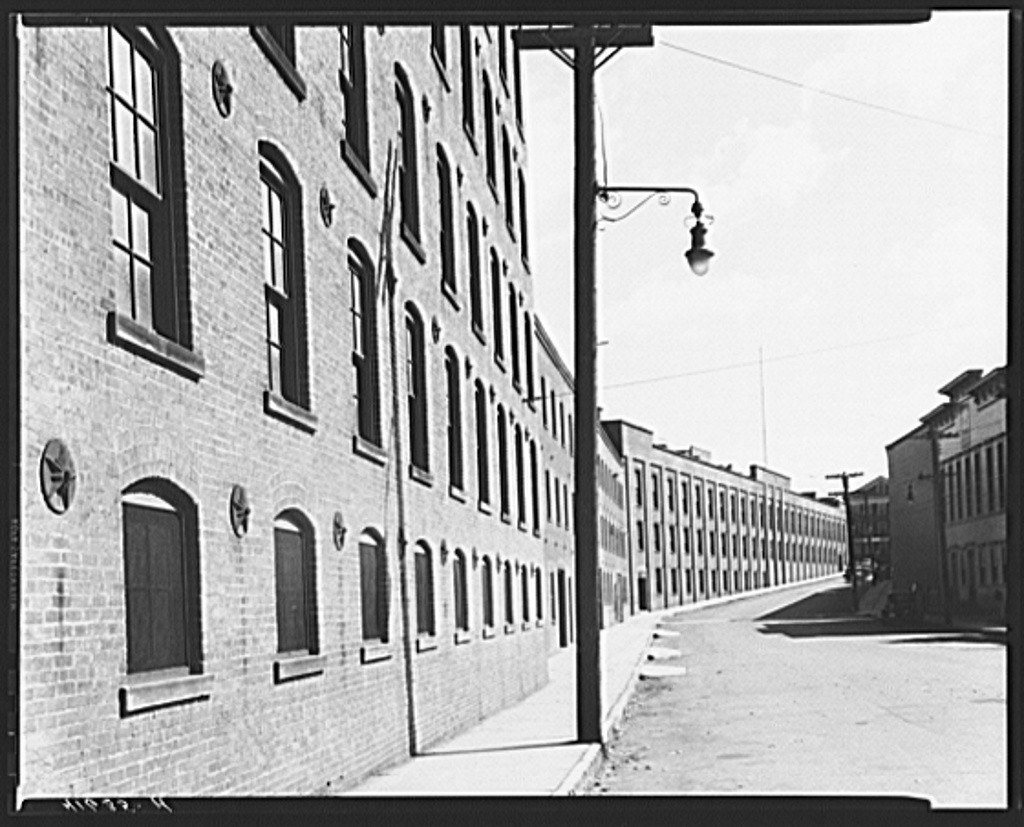
Thompsonville carpet mill, September 1940
Thompsonville carpet mill, September 1940 — 1940 Sept.
Image credit & source
Delano, Jack, 1914-1997 / Library of Congress, Prints and Photographs Division
Public domain; federal FSA/OWI photograph. Library of Congress reports no known restrictions on U.S. Government images.
Original source · Reuse terms1940 Sept.
Thompsonville carpet mill, second view, 1940
Thompsonville carpet mill, second view, 1940 — 1940 Sept.
Image credit & source
Delano, Jack, 1914-1997 / Library of Congress, Prints and Photographs Division
Public domain; federal FSA/OWI photograph. Library of Congress reports no known restrictions on U.S. Government images.
Original source · Reuse termsTHE STORY BEHIND THE PHOTOGRAPHS
People, places, and change.
An industry already changing by 1850
Carpet making began in Thompsonville in the late 1820s, giving Enfield an industrial village named for founder Orrin Thompson. By 1850 the mills were producing about 250,000 yards annually. Power looms and expanded buildings increased capacity, but prosperity was not assured: financial distress and reorganization soon followed. The history of the mills is therefore also a history of investment, debt and repeated efforts to make production competitive. [1]
Expansion and changing company names
The Hartford Carpet Company and its successors expanded the operation in the later nineteenth and early twentieth centuries. A 1901 merger brought a major building campaign; further combinations produced Bigelow-Hartford in 1914 and Bigelow-Sanford in 1929. These names matter to researchers because employment and business records may be filed under different corporate identities even when they concern the same Thompsonville workforce. [1] [2]
Photographing the mill in 1940
Jack Delano photographed the Thompsonville carpet mill in September 1940 for the Farm Security Administration. These views provide a dated record just before the United States entered the Second World War. Their value lies in specificity: they show this mill at a particular stage rather than standing in for every Connecticut textile works. During the war, the company’s production included blankets and other military materials, connecting the local landscape to national mobilization. [3] [4] [1]
Closure and the records of ordinary lives
The Thompsonville plant closed in 1971, ending more than a century of carpet manufacture. Enfield Historical Society’s collection preserves material from the company’s changing incarnations, particularly the 1914–1929 and 1929–1971 periods. Its finding aid emphasizes workers and management as people, not only products and machinery. That documentary perspective gives the industrial buildings a human history and provides a path for family researchers to move from a company name to evidence of a working life. [2]
Keep the sources close.
Download this collection’s notes, timeline and image credits. Photographs link to their original archives and require an internet connection.
Building dates and photograph dates are recorded separately. Later photographs are identified in their captions; unknown exposure dates remain unknown. Follow each image’s credit and reuse terms.