
New London COUNTY · Shipbuilding and maritime labor
Thames Shipyard: Tugs, Steam Railways, and Repair Shops
Explore New London’s tug-and-barge repair landscape through workshop, machinery, waterfront, and aerial photographs made in 1975–1978.
Historical focus · 1865–1978
LOOK CLOSER · OPEN ANY IMAGE
The story in photographs
1975–1978 (survey photography; individual exposure year not specified)
Marine Railway Headhouse and Offices, west side
Marine Railway Headhouse and Offices, west side. — Thames Tow Boat Company, Foot of Farnsworth Street, New London, New London County, CT
Image credit & source
Jack E. Boucher and Norman E. C. Sill (survey photographers; individual attribution not specified); Library of Congress, Prints and Photographs Division, HABS/HAER.
No known restrictions on images made by the U.S. Government; images copied from other sources may be restricted.
Original source · Reuse terms1975–1978 (survey photography; individual exposure year not specified)
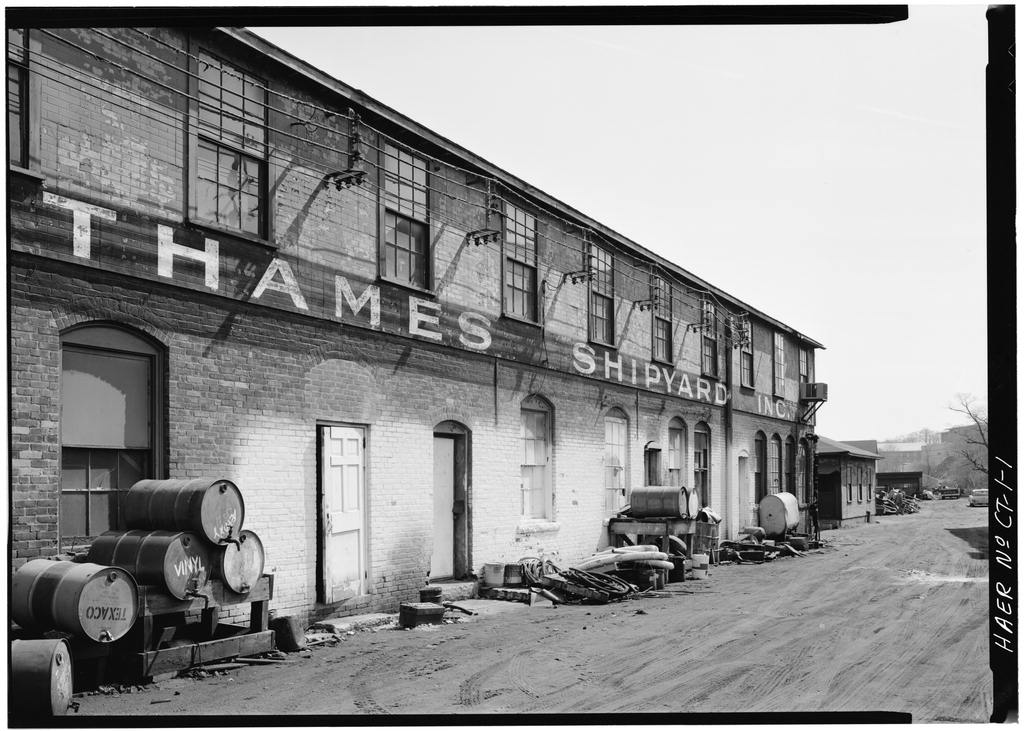
Left to right: Machine Shop and Boiler Works, east side; on right in distance--Pipe, Paint, and Electrical Shop
Left to right: Machine Shop and Boiler Works, east side; on right in distance--Pipe, Paint, and Electrical Shop. — Thames Tow Boat Company, Foot of Farnsworth Street, New London, New London County, CT
Image credit & source
Jack E. Boucher and Norman E. C. Sill (survey photographers; individual attribution not specified); Library of Congress, Prints and Photographs Division, HABS/HAER.
No known restrictions on images made by the U.S. Government; images copied from other sources may be restricted.
Original source · Reuse terms1975–1978 (survey photography; individual exposure year not specified)
Marine Railway #3, detail
Marine Railway #3, detail. — Thames Tow Boat Company, Foot of Farnsworth Street, New London, New London County, CT
Image credit & source
Jack E. Boucher and Norman E. C. Sill (survey photographers; individual attribution not specified); Library of Congress, Prints and Photographs Division, HABS/HAER.
No known restrictions on images made by the U.S. Government; images copied from other sources may be restricted.
Original source · Reuse terms1975–1978 (survey photography; individual exposure year not specified)
Storehouse and Boathouse as viewed from tunnel under second floor of Pipe, Paint, and Electrical Shop
Storehouse and Boathouse as viewed from tunnel under second floor of Pipe, Paint, and Electrical Shop. — Thames Tow Boat Company, Foot of Farnsworth Street, New London, New London County, CT
Image credit & source
Jack E. Boucher and Norman E. C. Sill (survey photographers; individual attribution not specified); Library of Congress, Prints and Photographs Division, HABS/HAER.
No known restrictions on images made by the U.S. Government; images copied from other sources may be restricted.
Original source · Reuse terms1975–1978 (survey photography; individual exposure year not specified)
Hose House and Paint Storage, looking south along east side
Hose House and Paint Storage, looking south along east side. — Thames Tow Boat Company, Foot of Farnsworth Street, New London, New London County, CT
Image credit & source
Jack E. Boucher and Norman E. C. Sill (survey photographers; individual attribution not specified); Library of Congress, Prints and Photographs Division, HABS/HAER.
No known restrictions on images made by the U.S. Government; images copied from other sources may be restricted.
Original source · Reuse terms1975–1978 (survey photography; individual exposure year not specified)
Yacht Storage Shed, south side and west end
Yacht Storage Shed, south side and west end. — Thames Tow Boat Company, Foot of Farnsworth Street, New London, New London County, CT
Image credit & source
Jack E. Boucher and Norman E. C. Sill (survey photographers; individual attribution not specified); Library of Congress, Prints and Photographs Division, HABS/HAER.
No known restrictions on images made by the U.S. Government; images copied from other sources may be restricted.
Original source · Reuse terms1975–1978 (survey photography; individual exposure year not specified)
Headhouse (1919), to left, foreground; Storage and Joiner Shop in back; Marine Railway Headhouse and Offices, to right
Headhouse (1919), to left, foreground; Storage and Joiner Shop in back; Marine Railway Headhouse and Offices, to right. — Thames Tow Boat Company, Foot of Farnsworth Street, New London, New London County, CT
Image credit & source
Jack E. Boucher and Norman E. C. Sill (survey photographers; individual attribution not specified); Library of Congress, Prints and Photographs Division, HABS/HAER.
No known restrictions on images made by the U.S. Government; images copied from other sources may be restricted.
Original source · Reuse terms1975–1978 (survey photography; individual exposure year not specified)
Steam powered Marine Railway Headhouse and Offices, center; chain is in front of electric powered Marine Railway…
Steam powered Marine Railway Headhouse and Offices, center; chain is in front of electric powered Marine Railway Headhouse. — Thames Tow Boat Company, Foot of Farnsworth Street, New London, New London County, CT
Image credit & source
Jack E. Boucher and Norman E. C. Sill (survey photographers; individual attribution not specified); Library of Congress, Prints and Photographs Division, HABS/HAER.
No known restrictions on images made by the U.S. Government; images copied from other sources may be restricted.
Original source · Reuse terms1975–1978 (survey photography; individual exposure year not specified)
Blacksmith Shop, Compressor Room, Boiler Room, and Marine Railway Headhouse and Offices on left side of road;…
Blacksmith Shop, Compressor Room, Boiler Room, and Marine Railway Headhouse and Offices on left side of road; Storage and Joiner Shop, and Sawmill on right side of road. — Thames Tow Boat Company, Foot of Farnsworth Street, New London, New London County, CT
Image credit & source
Jack E. Boucher and Norman E. C. Sill (survey photographers; individual attribution not specified); Library of Congress, Prints and Photographs Division, HABS/HAER.
No known restrictions on images made by the U.S. Government; images copied from other sources may be restricted.
Original source · Reuse terms1975–1978 (survey photography; individual exposure year not specified)
Tug tied to Pier #5
Tug tied to Pier #5. — Thames Tow Boat Company, Foot of Farnsworth Street, New London, New London County, CT
Image credit & source
Jack E. Boucher and Norman E. C. Sill (survey photographers; individual attribution not specified); Library of Congress, Prints and Photographs Division, HABS/HAER.
No known restrictions on images made by the U.S. Government; images copied from other sources may be restricted.
Original source · Reuse terms1975–1978 (survey photography; individual exposure year not specified)
Detail of belt driven lathe for turning shafts, Machine Shop
Detail of belt driven lathe for turning shafts, Machine Shop. — Thames Tow Boat Company, Foot of Farnsworth Street, New London, New London County, CT
Image credit & source
Jack E. Boucher and Norman E. C. Sill (survey photographers; individual attribution not specified); Library of Congress, Prints and Photographs Division, HABS/HAER.
No known restrictions on images made by the U.S. Government; images copied from other sources may be restricted.
Original source · Reuse terms1975–1978 (survey photography; individual exposure year not specified)
Looking down electric powered Marine Railway #3
Looking down electric powered Marine Railway #3. — Thames Tow Boat Company, Foot of Farnsworth Street, New London, New London County, CT
Image credit & source
Jack E. Boucher and Norman E. C. Sill (survey photographers; individual attribution not specified); Library of Congress, Prints and Photographs Division, HABS/HAER.
No known restrictions on images made by the U.S. Government; images copied from other sources may be restricted.
Original source · Reuse termsTHE STORY BEHIND THE PHOTOGRAPHS
People, places, and change.
A business built around towing
The Thames Tow Boat Company organized in Norwich in December 1865. Its work linked coastal shipping with the coal trade, using tugboats and barges to move material through regional waters. Frank Huntington Chappell, who established a coal and wood business after returning from the Civil War, acquired control of the towing concern in 1878. The later New London yard grew out of this practical need to build, maintain, and repair vessels. It belonged to a transportation economy in which the work of a harbor continued well beyond the moment a ship reached a dock. [2]
A yard of specialized trades
Designed in 1900 and built in 1901–1903, the Farnsworth Street shipyard brought together marine railways and numerous workshops. Vessels could be hauled out of the water on cradles for repair. Blacksmithing, boiler work, machine work, joinery, pattern storage, and sawmilling each required spaces and equipment. The photographed complex makes those trades visible through its buildings and their relationships to the waterfront. A repair yard depended on movement between these places: a damaged vessel might require woodwork, metalwork, machinery repairs, and handling equipment rather than a single isolated operation. [2] [3]
Old power and new demands
During the First World War, naval repair work brought additional demands and equipment to the yard. Electrification changed portions of the shops, but steam continued to serve important functions. The federal survey drew attention to the survival of steam-powered marine railway machinery and an unusually complete arrangement of older industrial facilities. The towing company dissolved in 1931, while the yard continued under the Thames Shipyard name. These changes caution against treating the site as a frozen relic: successive owners and changing contracts adapted a working waterfront while preserving much of its earlier fabric. [2] [4]
Reading the 1970s photographs
The photographic index credits Jack E. Boucher and Norman E. C. Sill and dates the survey photography to 1975 and 1978. Selected views range from a tug at a pier and aerial overviews to shaft-turning lathes, belt drives, and the marine railway cradles. They allow a visitor to move from the layout of the whole yard to the tools used within it. Where the index does not identify the individual photographer or exact year of a particular exposure, the archive preserves that uncertainty instead of assigning a more precise credit. [3]
Sources & further reading (4)
Keep the sources close.
Download this collection’s notes, timeline and image credits. Photographs link to their original archives and require an internet connection.
Building dates and photograph dates are recorded separately. Later photographs are identified in their captions; unknown exposure dates remain unknown. Follow each image’s credit and reuse terms.