CollectionsBarnum & Bailey Circus: Bridgeport and New Haven
COLLECTION 024 · SGC-CIRCUS-024
Barnum & Bailey Circus: Bridgeport and New Haven
Entertainment and public life · photographs, documents & local history
Bridgeport winter quarters and a documented New Haven circus day, told through nineteenth-century engravings, a touring poster, a postcard, and local newspaper evidence from June 1908.
OPENING / FIRST RECORDED DATELocal winter-quarters opening date not established
FOUNDED / HISTORICAL PERIOD1881 (Barnum–Bailey partnership)
The 1881 date refers to the Barnum, Bailey and Hutchinson partnership, not the first opening of Bridgeport winter quarters. This collection documents the quarters by 1886 and a New Haven appearance on June 18, 1908; it does not claim either was the first local circus activity. Barnum was born in Bethel, not Bridgeport.
LOOK CLOSER · OPEN ANY IMAGE
The story in photographs
9 images
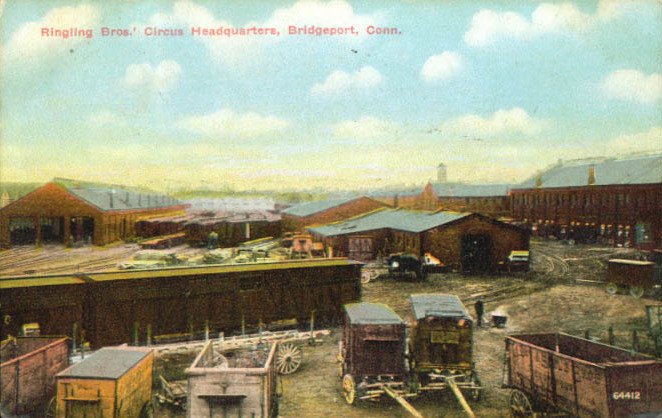
1911 reported postmark; view undated
A later name on familiar grounds
The postcard says Ringling Bros., not Barnum & Bailey. Its reported 1911 postmark places it after the Ringling purchase while preserving the distinction between a mailed card and an exactly dated photograph.
Image credit & source
Unidentified postcard maker; Wikimedia Commons, sourced from a postcard listing that reported a 1911 postmark.
The Bridgeport engraving puts sheds, rail cars and animal care in the same frame. Orcutt’s accompanying account says the circus rested here for about five months a year: the touring spectacle required a substantial seasonal home.
Image credit & source
Samuel Orcutt, A History of the Old Town of Stratford and City of Bridgeport, vol. 2 (Fairfield County Historical Society, 1886); Internet Archive digitization.
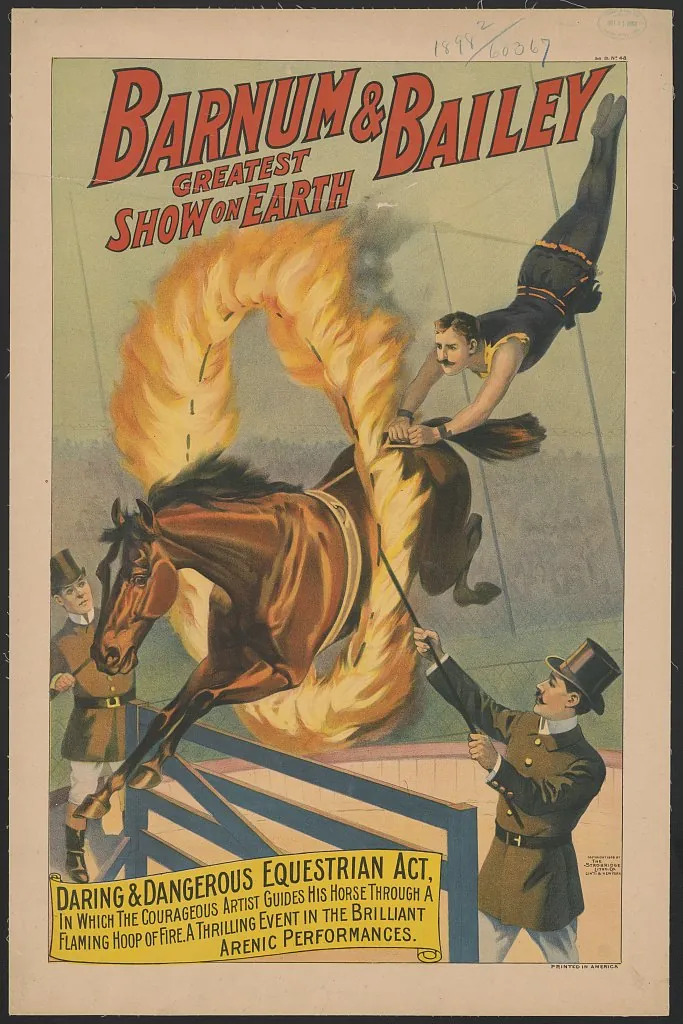
A color company poster displaying portraits of P. T. Barnum and James A. Bailey. This is touring-company context for the two Connecticut locations; it does not advertise either city by name.
Image credit & source
Library of Congress, Prints and Photographs Division, catalog item 2002719029.
New Haven readers could buy show-day tickets at Mix’s Drug Store. The advertisement’s June 18 date connects its familiar Barnum & Bailey branding to a specific local visit.
Image credit & source
The New Haven Union, June 17, 1908, image 14; Connecticut State Library / National Digital Newspaper Program / Library of Congress.
Issued 1908-06-16; published 1908-06-18; effective 1908-06-18
Circus day changes the street
A mayoral order closed part of Derby Avenue to most vehicles from 11 a.m. to 11 p.m. Streetcars were exempt, making the notice an unusually concrete record of how New Haven handled circus traffic.
Image credit & source
City of New Haven notice in The New Haven Union, June 18, 1908, image 11; Connecticut State Library / National Digital Newspaper Program / Library of Congress.
Read the full story of Barnum & Bailey Circus: Bridgeport and New Haven
COLLECTION HISTORY
The people behind the place.
Barnum & Bailey emerged from the 1881 combination involving P. T. Barnum, James A. Bailey and James L. Hutchinson. For this collection, the important distinction is between a touring enterprise and its Connecticut places: Bridgeport supplied a winter home, while New Haven received a temporary visiting show. The partnership date does not establish when the Bridgeport grounds first opened. [CIRCUS-011]
Bridgeport was more than a name on an itinerary. Samuel Orcutt’s 1886 local history described the circus as resting in the city for about five months of each year and said its winter quarters for animals and carriages covered several acres. His favorable account is a contemporary civic portrait, useful for the scale and seasonal role it records, though its praise should be read as local boosterism. [CIRCUS-012]
The visual record makes that working landscape tangible. The 1886 engraving shows substantial sheds, railway cars and animals, and the 1891 handbook explicitly labels its view as the Bridgeport winter quarters of Barnum & Bailey. These are published illustrations, not photographs. Barnum’s connection to Bridgeport also extended into civic life: the Bridgeport History Center records his election as mayor in 1875 and his death there in 1891. [CIRCUS-010]
A narrow advertisement in the New Haven Union of June 17, 1908 announces the next day’s Barnum & Bailey show. It promises a morning street parade, performances at 2 and 8 p.m., and tickets available at Mix’s Drug Store. The animals, international performers and automobile stunt belong to the advertiser’s sales pitch; the local newspaper placement and dated announcement securely anchor this piece to New Haven. [CIRCUS-004]
The June 18 Union then reported the circus’s early arrival, a parade through crowded streets and an afternoon audience at the grounds. On another page, Mayor James B. Martin’s order restricted Derby Avenue between Chapel Street and the city line from 11 a.m. to 11 p.m., with an exception for streetcars. Together the report and official notice show both the excitement of a visit and the practical work of moving its crowds. [CIRCUS-005]
The Ringling brothers purchased Barnum & Bailey in 1907; the two shows continued separately until their 1919 combination. A Bridgeport postcard reported as postmarked in 1911 bears the Ringling name and depicts circus headquarters with rail cars in the foreground. It is included as evidence of the city’s continuing circus infrastructure, with the mailing date kept separate from the unknown date of the underlying view. [CIRCUS-011]
The circus was temporary for a New Haven audience but seasonal work and infrastructure for Bridgeport. Winter quarters, railway cars and storage buildings supported the touring spectacle. Advertisements emphasized attractions; a city traffic order reveals another side of the visit, organizing streets and crowds. The June 1908 announcement and next-day report can be compared to distinguish what promoters promised from what a reporter said occurred. Published animal and performance imagery should also be read as part of the business’s presentation. Keeping those perspectives separate makes it possible to study entertainment as work, transport and municipal coordination as well as popular excitement. [CIRCUS-011] [CIRCUS-012] [CIRCUS-010]
ESTABLISHED1881 (Barnum–Bailey partnership)
EARLIEST HISTORYLocal winter-quarters opening date not established
The 1881 date refers to the Barnum, Bailey and Hutchinson partnership, not the first opening of Bridgeport winter quarters. This collection documents the quarters by 1886 and a New Haven appearance on June 18, 1908; it does not claim either was the first local circus activity. Barnum was born in Bethel, not Bridgeport.
About this research edition. Bridgeport is the documented winter-quarters city. New Haven is represented by city-specific advertisements, reporting and a municipal traffic order. The 1897 portrait poster identifies the touring company but has no local imprint. The Ringling-named postcard is later ownership context.
THE SEARCHABLE CATALOG
Images, maps & original records
Search includes catalog notes and the OCR text included with this edition. OCR may misread names or dates; use the original scan to verify a match.
A contemporary engraved overview of the Bridgeport winter quarters, with railway cars, large buildings and animals. The original printed caption uses the Barnum-London name.
A color company poster displaying portraits of P. T. Barnum and James A. Bailey. This is touring-company context for the two Connecticut locations; it does not advertise either city by name.
The New Haven Union advertises Barnum & Bailey for Thursday, June 18, 1908, including a street parade, two performances, and tickets at Mix’s Drug Store.
Mayor James B. Martin restricts most vehicles on Derby Avenue between Chapel Street and the city line from 11 a.m. to 11 p.m. on circus day, exempting streetcars.
Extract the ZIP and open START_HERE.html. It includes the catalog, selected images, acquired source text, credits and a searchable SQLite database. New photo additions are hosted in the SGC media library and require an internet connection; original bundled images remain available offline.



.jpg)
_p144_BRIDGEPORT,_WINTER-QUARTERS_OF_BARNUM_%26_BAILEY%27S_CIRCUS.jpg)