
Middlesex COUNTY · Industry & working life
East Hampton: inside the bell shops
Foundry pits, molten brass and hand work in the town known for its bells.
Historical focus · 1850–1999
LOOK CLOSER · OPEN ANY IMAGE
The story in photographs
1979
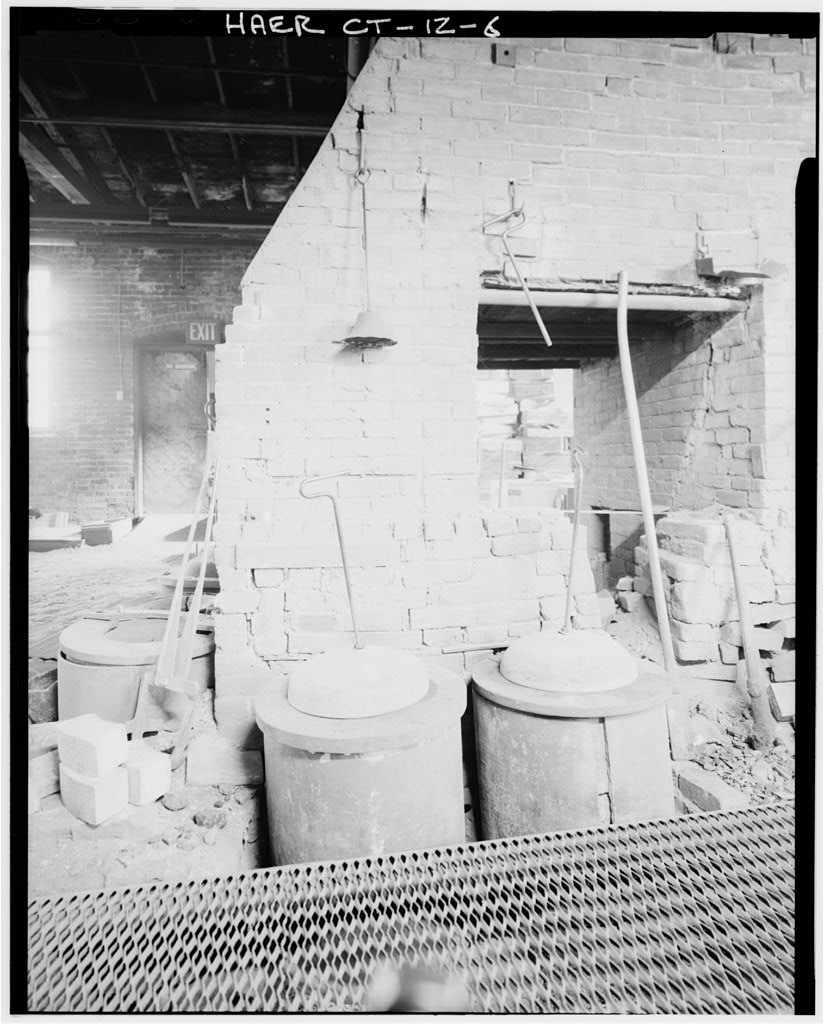
DETAIL VIEW OF FOUNDRY PITS - Bevin Brothers Bell Shops, Bevin Court, East Hampton, Middlesex County, CT
DETAIL VIEW OF FOUNDRY PITS - Bevin Brothers Bell Shops, Bevin Court, East Hampton, Middlesex County, CT
Image credit & source
Jet Lowe / Historic American Buildings Survey–Historic American Engineering Record, Library of Congress
No known restrictions on images made by the U.S. Government; images copied from other sources may be restricted.
Original source · Reuse terms1979
DETAIL VIEW OF FURNACE AND FOUNDRY PITS - Bevin Brothers Bell Shops, Bevin Court, East Hampton, Middlesex County, CT
DETAIL VIEW OF FURNACE AND FOUNDRY PITS - Bevin Brothers Bell Shops, Bevin Court, East Hampton, Middlesex County, CT
Image credit & source
Jet Lowe / Historic American Buildings Survey–Historic American Engineering Record, Library of Congress
No known restrictions on images made by the U.S. Government; images copied from other sources may be restricted.
Original source · Reuse terms1979
DETAIL VIEW OF HAND CAST BRASS BELLS AND KNOCKERS - Bevin Brothers Bell Shops, Bevin Court, East Hampton, Middlesex…
DETAIL VIEW OF HAND CAST BRASS BELLS AND KNOCKERS - Bevin Brothers Bell Shops, Bevin Court, East Hampton, Middlesex County, CT
Image credit & source
Jet Lowe / Historic American Buildings Survey–Historic American Engineering Record, Library of Congress
No known restrictions on images made by the U.S. Government; images copied from other sources may be restricted.
Original source · Reuse terms1979
DETAIL VIEW OF PIT FURNACE - Bevin Brothers Bell Shops, Bevin Court, East Hampton, Middlesex County, CT
DETAIL VIEW OF PIT FURNACE - Bevin Brothers Bell Shops, Bevin Court, East Hampton, Middlesex County, CT
Image credit & source
Jet Lowe / Historic American Buildings Survey–Historic American Engineering Record, Library of Congress
No known restrictions on images made by the U.S. Government; images copied from other sources may be restricted.
Original source · Reuse terms1979
DETAIL VIEW OF WORKBENCH - Bevin Brothers Bell Shops, Bevin Court, East Hampton, Middlesex County, CT
DETAIL VIEW OF WORKBENCH - Bevin Brothers Bell Shops, Bevin Court, East Hampton, Middlesex County, CT
Image credit & source
Jet Lowe / Historic American Buildings Survey–Historic American Engineering Record, Library of Congress
No known restrictions on images made by the U.S. Government; images copied from other sources may be restricted.
Original source · Reuse terms1979
GENERAL INTERIOR VIEW TOWARD PIT FURNACE - Bevin Brothers Bell Shops, Bevin Court, East Hampton, Middlesex County, CT
GENERAL INTERIOR VIEW TOWARD PIT FURNACE - Bevin Brothers Bell Shops, Bevin Court, East Hampton, Middlesex County, CT
Image credit & source
Jet Lowe / Historic American Buildings Survey–Historic American Engineering Record, Library of Congress
No known restrictions on images made by the U.S. Government; images copied from other sources may be restricted.
Original source · Reuse terms1979
GENERAL VIEW OF MOLTEN BRASS BEING POURED INTO BELL MOLDS - Bevin Brothers Bell Shops, Bevin Court, East Hampton,…
GENERAL VIEW OF MOLTEN BRASS BEING POURED INTO BELL MOLDS - Bevin Brothers Bell Shops, Bevin Court, East Hampton, Middlesex County, CT
Image credit & source
Jet Lowe / Historic American Buildings Survey–Historic American Engineering Record, Library of Congress
No known restrictions on images made by the U.S. Government; images copied from other sources may be restricted.
Original source · Reuse terms1979
VIEW OF COOLING BELL MOLDS - Bevin Brothers Bell Shops, Bevin Court, East Hampton, Middlesex County, CT
VIEW OF COOLING BELL MOLDS - Bevin Brothers Bell Shops, Bevin Court, East Hampton, Middlesex County, CT
Image credit & source
Jet Lowe / Historic American Buildings Survey–Historic American Engineering Record, Library of Congress
No known restrictions on images made by the U.S. Government; images copied from other sources may be restricted.
Original source · Reuse terms1979
VIEW OF COOLING CRUCIBLE - Bevin Brothers Bell Shops, Bevin Court, East Hampton, Middlesex County, CT
VIEW OF COOLING CRUCIBLE - Bevin Brothers Bell Shops, Bevin Court, East Hampton, Middlesex County, CT
Image credit & source
Jet Lowe / Historic American Buildings Survey–Historic American Engineering Record, Library of Congress
No known restrictions on images made by the U.S. Government; images copied from other sources may be restricted.
Original source · Reuse termsTHE STORY BEHIND THE PHOTOGRAPHS
People, places, and change.
An industry already established by 1850
Bell manufacturing grew from early-nineteenth-century beginnings into East Hampton’s defining industry. The town’s history identifies the Bevin company among the manufacturers behind its Belltown identity. Knowledge of working brass also supported the manufacture of other metal products, so the industrial story reaches beyond a single kind of bell. [1] [2]
Railroads, power and changing markets
During the industrial period from 1850 to 1930, improved rail connections helped move products and materials, while electricity offered another source of power. Wartime demand aided local manufacturing. The Depression sharply reduced bell sales, and firms responded by making a broader range of products. The town’s industrial buildings record these changing uses. [1]
Work documented in 1979
Jet Lowe’s 1979 Historic American Engineering Record photographs take the viewer inside the Bevin shops. They follow the handling of molten brass, casting molds, cooling crucibles and finished bells. These images are records of skilled labor and equipment in use, allowing close comparison between a work space, a process and its product. [3]
Keep the sources close.
Download this collection’s notes, timeline and image credits. Photographs link to their original archives and require an internet connection.
Building dates and photograph dates are recorded separately. Later photographs are identified in their captions; unknown exposure dates remain unknown. Follow each image’s credit and reuse terms.