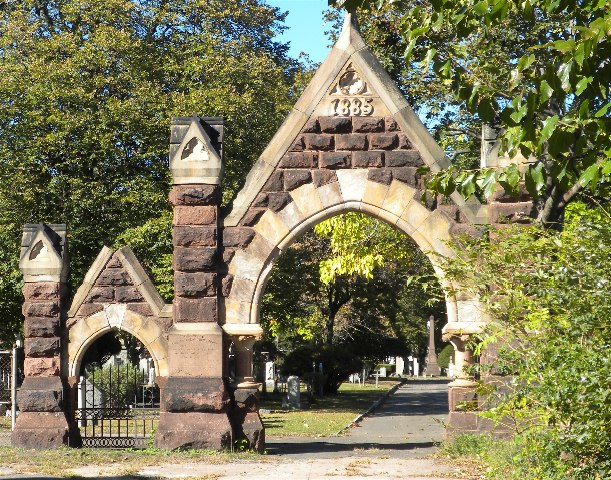
Fair Haven Union Cemetery’s 1885 gateway · 2010-10
OPENING / FIRST RECORDED DATEEarly nineteenth century; graves as early as 1803 reported
FOUNDED / HISTORICAL PERIOD1808 land donation reported in local-history synthesis
The 1803 and 1808 dates are reported by the cited local-history synthesis, whose underlying land deed has not been acquired. The gateway bears 1885; that date is not the cemetery’s opening.
LOOK CLOSER · OPEN ANY IMAGE
The story in photographs
7 images
2010-10
Reading the gateway date
The stone date identifies the gateway’s construction period, decades after the cemetery’s reported beginnings. The wide and narrow openings also made this entrance a distinctive memorial in its own right.
The exterior photograph records roof forms, masonry and the building’s position among gravestones. It cannot establish unseen interior furnishings, a Tiffany attribution or the burial history beneath the structure.
The photographed obelisk is identified in its source as Herman Hotchkiss’s grave. Its relationship to the chapel is visible; the weathered inscription should be transcribed from a closer record before publishing exact lettering.
Fair Haven Union Cemetery occupies the Grand Avenue burial ground behind the Congregational church. A local-history synthesis reports graves from 1803 and a land donation by Stephen Rowe and Nathaniel Granniss in 1808, initially setting aside an acre for eighty burial lots within a broader community site. Those early details should remain attributed until the original deed and earliest interment evidence are inspected. [FHU-004]
By 1887, Atwater described Fair Haven’s cemetery behind the First Congregational Church as a Protestant burial ground. That contemporary description establishes its church-side location and distinguishes it from the other cemeteries in his city survey. The same page discusses Evergreen and Westville separately, a useful reminder that neighboring burial institutions had their own histories and records. [FHU-010]
The cemetery belongs to Fair Haven’s waterfront history. Benjamin A. Gorman’s Yale–New Haven Teachers Institute field study describes a seven-acre Union Cemetery containing graves of early seamen. His neighborhood study connects this population with oystering, shipping, shipbuilding and repair. That occupational context helps explain the burial ground’s local importance, but is not a substitute for identifying an individual sailor through an inscription or record. [FHU-011]
The brownstone gateway carries the date 1885. Stephen Kobasa’s 2010 architectural account draws attention to its two unequal arches and to the donor’s remembrance of a mother and youthful friends. The public-domain photograph taken later that year preserves the visible date and form. It documents the gateway in 2010, rather than providing a view of the cemetery at its opening. [FHU-012]
Other visible features include the Soldiers Memorial Chapel and the nearby Herman Hotchkiss obelisk. The selected public-domain photographs preserve their appearance in October 2010. They supply a dated exterior record: roof forms, masonry and the relationship between a building and surrounding memorials. Interior furnishings, construction costs and burials beneath the chapel require different documentary evidence. [FHU-002]
Seamen’s graves connect the cemetery with Fair Haven’s shipping, shipbuilding and oyster economy, but an occupation must be established person by person. A neighborhood history supplies context; an inscription or individual record supplies a specific connection. The 1885 gateway and later memorial features add architectural layers to the earlier burial ground. Their dates should not be substituted for the cemetery’s origins. Photographs of the arches, chapel and monuments can support careful observation of form and material. Deeds, registers and family records are needed to extend that observation into a full account of ownership, burial and remembrance. [FHU-004] [FHU-010] [FHU-011]
ESTABLISHED1808 land donation reported in local-history synthesis
EARLIEST HISTORYEarly nineteenth century; graves as early as 1803 reported
The 1803 and 1808 dates are reported by the cited local-history synthesis, whose underlying land deed has not been acquired. The gateway bears 1885; that date is not the cemetery’s opening.
About this research edition. The cemetery at 149 Grand Avenue in New Haven’s Fair Haven neighborhood. Three public-domain 2010 documentary photographs show historic features. The collection has no complete interment register and no acquired original 1808 deed; historic photographs, chapel construction documents and inscription indexes remain leads.
THE SEARCHABLE CATALOG
Images, maps & original records
Search includes catalog notes and the OCR text included with this edition. OCR may misread names or dates; use the original scan to verify a match.
The dated brownstone gateway at Fair Haven Union Cemetery, photographed in October 2010. The visible 1885 is the gateway date, not the photograph date.
Exterior of the Soldiers Memorial Chapel in Fair Haven Union Cemetery, photographed in October 2010. This is a modern documentary view of the historic building.
The obelisk identified by its photographer as Herman Hotchkiss’s grave, with part of the chapel behind it, photographed in October 2010. The photograph is not a complete inscription transcription.
Extract the ZIP and open START_HERE.html. It includes the catalog, selected images, acquired source text, credits and a searchable SQLite database. New photo additions are hosted in the SGC media library and require an internet connection; original bundled images remain available offline.