OPENING / FIRST RECORDED DATEMeriden Silver Plate: 1869–1870 formation and operation
FOUNDED / HISTORICAL PERIODIndustry collection; several founding dates
The 1906 account documents a January 24, 1870 factory purchase but prints an inconsistent 1879 organization-paper date. The exact incorporation date remains unresolved.
LOOK CLOSER · OPEN ANY IMAGE
The story in photographs
16 images
Undated postcard; after the 1898 company formation
International Silver’s Factory E and general office
The postcard labels International Silver’s Factory E and general office in Meriden. The source’s 1897 date conflicts with the company name, so this archive does not repeat it as a verified exposure date.
A Meriden Silver Plate Company butter pat takes the form of an artist’s palette and brushes. The date belongs to the object, not necessarily to the museum photograph.
Image credit & source
Made by Meriden Silver Plate Company; Public domain; Wikimedia Commons
Meriden Britannia and Meriden Silver Plate were distinct companies before they became part of International Silver. A 1906 history explains that production bearing the Silver Plate trademark moved into the Britannia works, while the vacated factory received Barbour operations from Hartford. A maker’s mark, a corporation, and a factory building therefore did not always tell the same story.
Image credit & source
Charles Bancroft Gillespie and George Munson Curtis; Journal Publishing Co., Meriden; A Century of Meriden: The Silver City, part III; New York Public Library; digitized by Google; Internet Archive
An illustration from Examples of Household Taste presents an elaborate punch bowl with matching cups. It records nineteenth-century product design; it is not a factory photograph.
Image credit & source
Internet Archive Book Images; No restrictions; Wikimedia Commons
A period illustration shows a sculptural hunting group associated with Meriden Britannia’s work. Its dramatic figures illustrate how the firm’s products could extend beyond ordinary table settings.
Image credit & source
Internet Archive Book Images; No restrictions; Wikimedia Commons
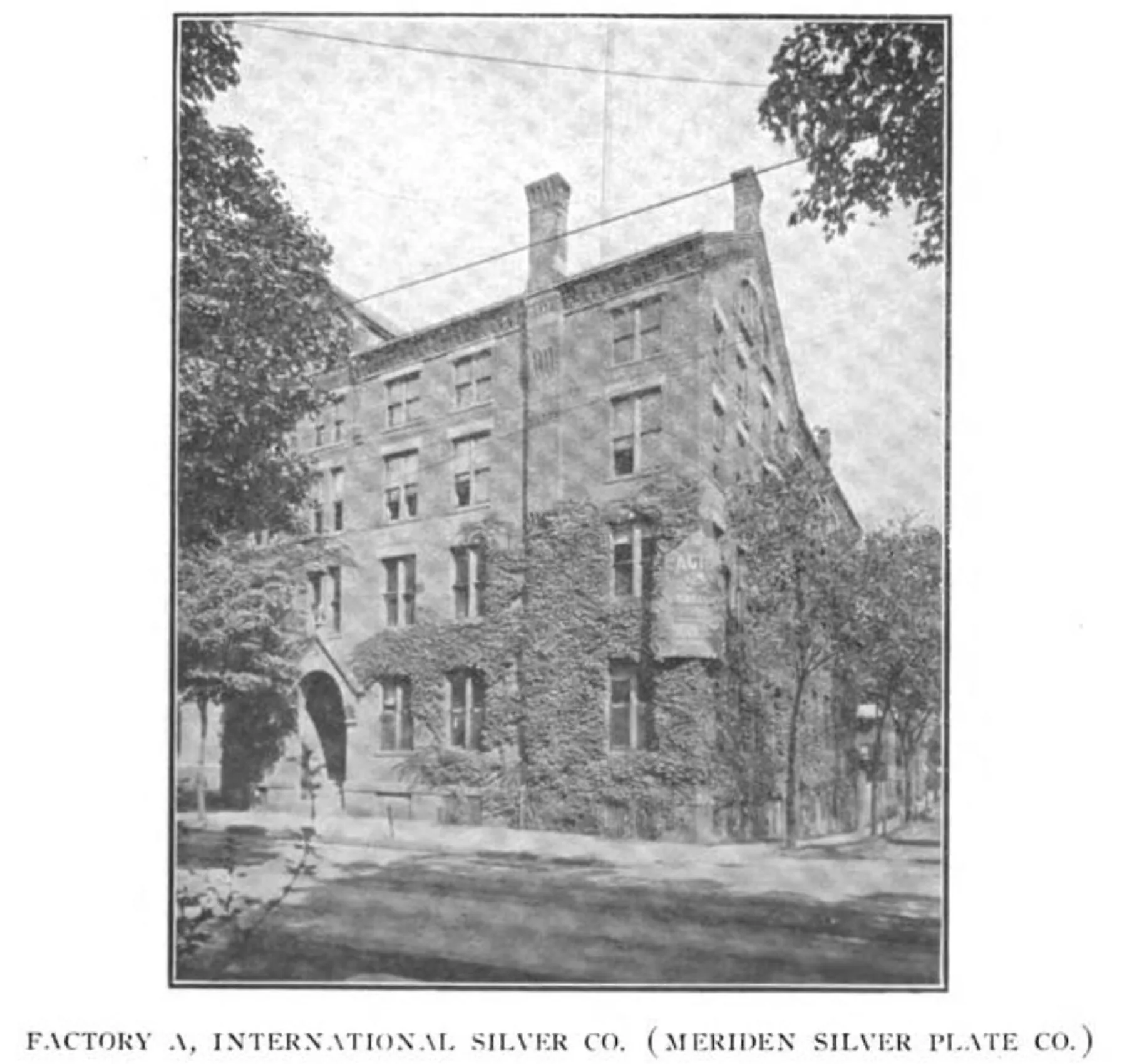
The 1906 book identifies Factory H as the former C. Rogers & Bros. works, one part of the broader Meriden industry.
Image credit & source
Charles Bancroft Gillespie and George Munson Curtis; Journal Publishing Co., Meriden; A Century of Meriden: The Silver City, part III; New York Public Library; digitized by Google; Internet Archive
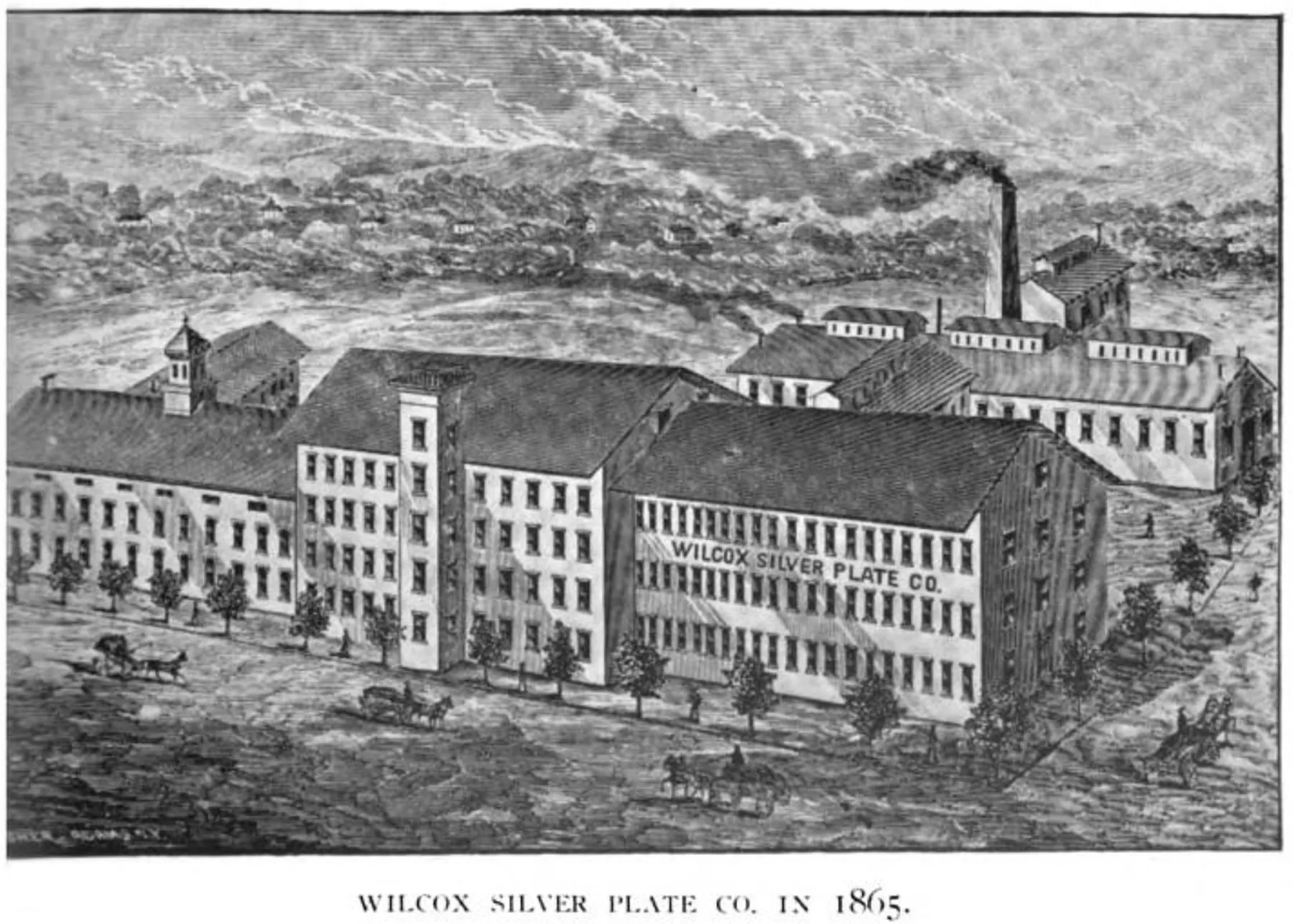
An engraved view labeled Wilcox Silver Plate Co. in 1865. The accompanying history says the firm began as Wilcox Britannia in December 1865 and adopted the Silver Plate name in 1867.
Image credit & source
Charles Bancroft Gillespie and George Munson Curtis; Journal Publishing Co., Meriden; A Century of Meriden: The Silver City, part III; New York Public Library; digitized by Google; Internet Archive
The Toronto branch’s cover for the Meriden Silver Plate Company’s Staple Goods catalog.
Image credit & source
Meriden Silver Plate Co.; printed by The Case, Lockwood & Brainard Co., Hartford; Illustrated catalogue and price list of staple goods, superior electro-silver plated ware manufactured by The Meriden Silver Plate Co.; Toronto Public Library, Toronto Reference Library; Internet Archive
The title page identifies the distinct Meriden Silver Plate Co., its Meriden factory, and salesrooms in New York, Chicago, and Toronto.
Image credit & source
Meriden Silver Plate Co.; printed by The Case, Lockwood & Brainard Co., Hartford; Illustrated catalogue and price list of staple goods, superior electro-silver plated ware manufactured by The Meriden Silver Plate Co.; Toronto Public Library, Toronto Reference Library; Internet Archive
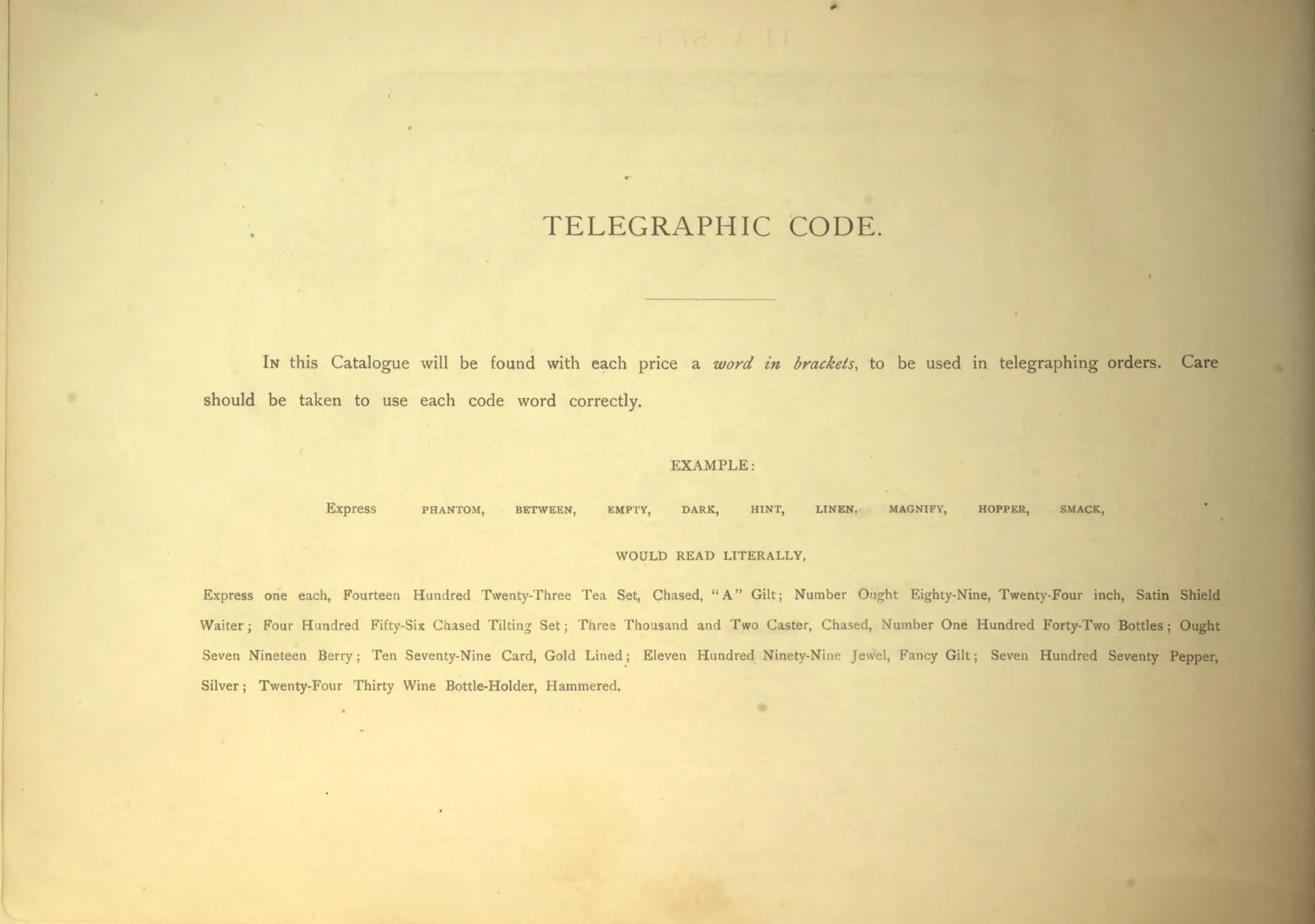
Meriden Silver Plate’s 1883 catalog paired prices with words in brackets. A retailer could telegram a string of those words to specify particular patterns and finishes. Its example begins with PHANTOM for a chased tea set. The catalog turns ornate objects into a compact ordering system that connected the factory, salesrooms, and dealers.
Image credit & source
Meriden Silver Plate Co.; printed by The Case, Lockwood & Brainard Co., Hartford; Illustrated catalogue and price list of staple goods, superior electro-silver plated ware manufactured by The Meriden Silver Plate Co.; Toronto Public Library, Toronto Reference Library; Internet Archive
The six-piece Satin Shield service is presented with matching extras, prices and ordering words. Its ornate illustration also serves a practical purpose: a retailer could connect a customer’s choice to a particular product entry. Other pages offer ice pitchers, replacement caster bottles and vases.
Image credit & source
Meriden Silver Plate Co.; printed by The Case, Lockwood & Brainard Co., Hartford; Illustrated catalogue and price list of staple goods, superior electro-silver plated ware manufactured by The Meriden Silver Plate Co.; Toronto Public Library, Toronto Reference Library; Internet Archive
Meriden silver was made by several companies. The 1906 city history dates Wilcox Britannia’s organization to December 1865 and its change to Wilcox Silver Plate in 1867. It places Meriden Silver Plate’s formation in the developments of 1869–1870 and records the purchase of the Canfield factory at Colony and Cross streets on January 24, 1870. Its inconsistent 1879 date for organization papers remains a question for the original filings. [MS-012]
Meriden Silver Plate’s 1883 catalog paired prices with words in brackets. A retailer could telegram a string of those words to specify particular patterns and finishes. Its example begins with PHANTOM for a chased tea set. The catalog turns ornate objects into a compact ordering system that connected the factory, salesrooms, and dealers. [MS-006]
Meriden Britannia and Meriden Silver Plate were distinct companies before they became part of International Silver. A 1906 history explains that production bearing the Silver Plate trademark moved into the Britannia works, while the vacated factory received Barbour operations from Hartford. A maker’s mark, a corporation, and a factory building therefore did not always tell the same story. [MS-015]
Later histories describe a gradual end to local production: Connecticut Explored dates the plated-hollowware division’s closure to March 20, 1981 and the remaining silver-business sale to 1983. Those events concern particular operations; they should not be treated as one closing day for every company in this collection. [MS-016]
The coded ordering words in the 1883 catalog connect decorative silverware with the practical world of dealers and communications. A telegram could name a pattern and finish without describing an elaborate object from scratch. This was a business system as well as a design catalog. Corporate consolidation complicated the relation between products and place: a familiar maker’s mark could continue while production moved into another works. The collection therefore follows multiple companies without collapsing them into one founding story. Later closure dates also belong to particular divisions or transactions. Comparing objects, marks, addresses and dated advertisements allows a student to reconstruct a chain of evidence rather than guess an object’s history from one name. [MS-012] [MS-006] [MS-015]
ESTABLISHEDIndustry collection; several founding dates
EARLIEST HISTORYMeriden Silver Plate: 1869–1870 formation and operation
The 1906 account documents a January 24, 1870 factory purchase but prints an inconsistent 1879 organization-paper date. The exact incorporation date remains unresolved.
About this research edition. This collection covers a connected industry, with every company named separately. Meriden Silver Plate was distinct from Meriden Britannia. Engravings and promotional illustrations are labeled as such. The later International Silver context includes a clearly identified Waterbury advertisement. This is a selected research edition, not a complete company archive.
THE SEARCHABLE CATALOG
Images, maps & original records
Search includes catalog notes and the OCR text included with this edition. OCR may misread names or dates; use the original scan to verify a match.
Meriden Silver Plate · Wilcox · C. Rogers & Bros. · International Silver
An engraved view labeled Wilcox Silver Plate Co. in 1865. The accompanying history says the firm began as Wilcox Britannia in December 1865 and adopted the Silver Plate name in 1867.
Meriden Silver Plate · Wilcox · C. Rogers & Bros. · International Silver
Rogers & Brother of Waterbury advertises a Columbia-pattern salad fork named for the exposition. This is a different firm from Meriden Britannia’s 1847 Rogers Bros. brand; it later joined International Silver.
Meriden Silver Plate · Wilcox · C. Rogers & Bros. · International Silver
Complete acquired repository OCR for this historical publication. Search additional names, product terms and addresses, then verify matches in the original scan.
Meriden Silver Plate · Wilcox · C. Rogers & Bros. · International Silver
Complete acquired repository OCR for this historical publication. Search additional names, product terms and addresses, then verify matches in the original scan.
Meriden Silver Plate · Wilcox · C. Rogers & Bros. · International Silver
The 1906 history links Charles Casper’s formation of Meriden Silver Plate Co. to the 1869 acquisition of Parker & Casper by Wilcox. It records the purchase of the old J. H. Canfield factory at Colony and Cross streets on January 24, 1870, followed immediately by silver-plated ware manufacture. The same printed page anomalously gives organization papers a January 3, 1879 date. This is internally inconsistent with the 1870 property purchase and 1872/1873 officers; do not silently change it or claim an exact incorporation date.
Meriden Silver Plate · Wilcox · C. Rogers & Bros. · International Silver
International Silver Company was organized under New Jersey law on November 19, 1898 and bought constituent company stock. The 1906 account distinguishes those acquisitions from the 1899 corporate mergers. It names Meriden Britannia and Meriden Silver Plate separately.
Meriden Silver Plate · Wilcox · C. Rogers & Bros. · International Silver
Connecticut Explored reports closure of International’s plated hollowware division on March 20, 1981 and sale of the remaining silver business by 1983. Secondary account by Patricia F. Singer, Winter 2015/16, drawing on interviews; avoid equating this one division’s closure with every Meriden silver operation.
Meriden Silver Plate · Wilcox · C. Rogers & Bros. · International Silver
CTHumanities summarizes the end of silverware production in Meriden as by 1984. Broader city-level endpoint differs in scope from the plated-hollowware closure and sale dates above.
Meriden Silver Plate · Wilcox · C. Rogers & Bros. · International Silver
University of Connecticut archival finding-aid lead. The endpoint was not accessible during this research pass; no collection records are represented as inspected.
The postcard labels International Silver’s Factory E and general office in Meriden. The source’s 1897 date conflicts with the company name, so this archive does not repeat it as a verified exposure date.
A Meriden Silver Plate Company butter pat takes the form of an artist’s palette and brushes. The date belongs to the object, not necessarily to the museum photograph.
An illustration from Examples of Household Taste presents an elaborate punch bowl with matching cups. It records nineteenth-century product design; it is not a factory photograph.
A period illustration shows a sculptural hunting group associated with Meriden Britannia’s work. Its dramatic figures illustrate how the firm’s products could extend beyond ordinary table settings.
Extract the ZIP and open START_HERE.html. It includes the catalog, selected images, acquired source text, credits and a searchable SQLite database. New photo additions are hosted in the SGC media library and require an internet connection; original bundled images remain available offline.





,_ca._1880_(CH_18650219).jpg)
_(14759206226).jpg)
_(14782193715).jpg)