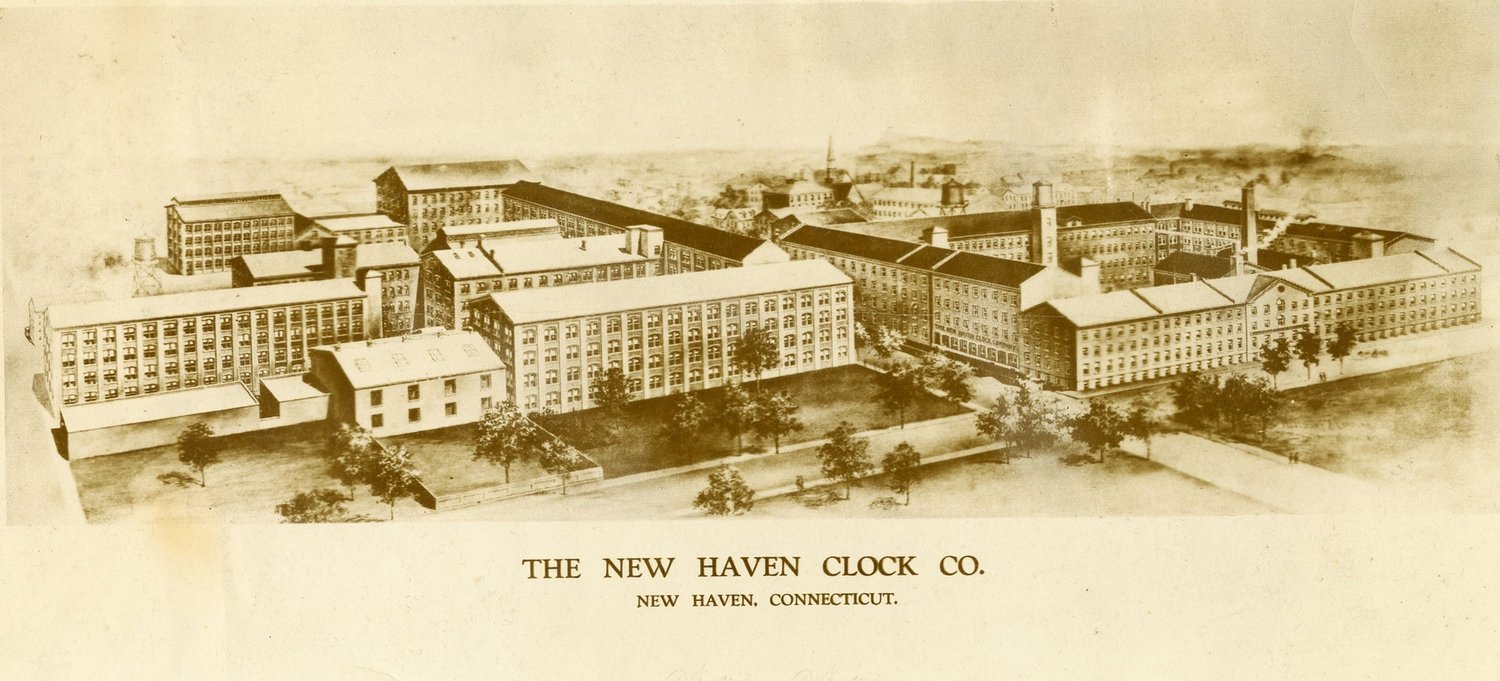
Factory panorama, dated 1920 · Original publication unidentified; rendering dated 1920 by Walk New Haven
OPENING / FIRST RECORDED DATEJerome case works: 1844; movement works: 1845
FOUNDED / HISTORICAL PERIODFebruary 7, 1853
Treat Clock Works as a descriptive collection label. Chauncey Jerome’s business preceded the company; the company was separately incorporated in 1853 and acquired Jerome Manufacturing in 1856.
LOOK CLOSER · OPEN ANY IMAGE
The story in photographs
10 images
2018-07-18 13:20:30
New Haven Clock Company factory
New Haven Clock Company Factory, New Haven, Connecticut.
The Thistle and Velvet models reproduced from New Haven Clock Company’s 1880 catalog. Their contrasting cases show the breadth of the firm’s decorative designs.
Image credit & source
New Haven Clock Company; Whitney Library, New Haven Museum; reproduced in NRHP nomination; Figure 1; PDF page 24
The Tennis Ink Set combines a clock with a themed desk object. Its catalog image places sporting imagery inside the home or office. The printed description identifies the oak base and finishes, allowing a researcher to connect design, use and sales language.
Image credit & source
New Haven Clock Company; Whitney Library, New Haven Museum; reproduced in NRHP nomination; Figure 2; PDF page 25
This catalog page offers a clock that attached to a gas fixture so its dial could be read at night. The printed patent date is May 14, 1872; the selected catalog page is dated 1890. An invention date and a catalog publication date are different evidence.
Image credit & source
New Haven Clock Company; Whitney Library, New Haven Museum; reproduced in NRHP nomination; Figure 3; PDF page 26
Original publication unidentified; rendering dated 1866 by Walk New Haven
Clock manufactory engraving, dated 1866
A factory engraving headed “Manufactured by New Haven Clock Co.” Walk New Haven dates the rendering to 1866. The image should not be described as a photograph.
Image credit & source
New Haven Clock Company; engraver signature appears to read W. Richardson, N.H. (unconfirmed); reproduced by Walk New Haven;
The advertisement gives a Chicago address, 31 Washington Street, and asks readers to request the 1885–86 catalog. That address documents a sales presence in the advertisement, not the relocation of the New Haven factory. The surviving scan is small; use the original source link for its publication context.
Image credit & source
New Haven Clock Company; period trade magazine unidentified; scan reproduced by AtticPaper;
Chauncey Jerome’s engraved portrait faces the title page of his 1860 autobiography. This is a period portrait reproduction, not a photograph of the factory.
Image credit & source
Portrait artist/engraver not confidently transcribed; published by F. C. Dayton, Jr.; Library of Congress copy; Frontispiece, PDF page 6
The title page of Jerome’s own account of the American clock business, published in New Haven in 1860. His personal account is a primary source that should be read with attention to his position in the company’s financial collapse.
Image credit & source
Chauncey Jerome; F. C. Dayton, Jr., publisher; Library of Congress copy; Title page, PDF page 7
Jerome brought case making to New Haven in 1844 and movement production in 1845. The separately incorporated New Haven Clock Company supplied his business, then acquired its assets in April 1856. The preservation nomination dates the company’s incorporation to February 7, 1853. [NC-010]
The catalogs show timekeeping combined with decoration: Thistle and Velvet cases, a tennis-themed ink set, a figurative clock and a night clock designed for a gas fixture. These product illustrations are primary evidence of what the company offered, while their descriptive claims remain advertising. [NC-001]
Chauncey Jerome’s 1860 autobiography offers a personal account of the trade and his financial collapse. Its portrait and title page establish the publication context. Read his account alongside the corporate chronology, rather than treating the predecessor business and the later company as interchangeable. [NC-009]
The catalog’s clocks were also furnishings. Named cases, figurative designs and combinations with desk or lighting objects show how sellers placed timekeeping within domestic and working interiors. These are illustrations of products offered for sale; they do not establish that every design was made in the same quantity or owned by a particular household. The company’s history is equally sensitive to distinctions. Jerome’s New Haven operations preceded the 1853 corporation, which later acquired his assets. His autobiography offers a participant’s explanation of that financial and industrial world, but his viewpoint requires comparison with company records. Together the sources make clock manufacture a story of design, business relationships and competing accounts of change. [NC-010] [NC-001] [NC-009]
ESTABLISHEDFebruary 7, 1853
EARLIEST HISTORYJerome case works: 1844; movement works: 1845
Treat Clock Works as a descriptive collection label. Chauncey Jerome’s business preceded the company; the company was separately incorporated in 1853 and acquired Jerome Manufacturing in 1856.
About this research edition. A selected primary-image and source collection, now including a licensed photograph of the New Haven Clock Company factory. Historical commercial renderings and engraved portraits are identified as illustrations. Additional photographs remain linked research leads. The predecessor Jerome business is distinguished from the 1853 company.
THE SEARCHABLE CATALOG
Images, maps & original records
Search includes catalog notes and the OCR text included with this edition. OCR may misread names or dates; use the original scan to verify a match.
The Thistle and Velvet models reproduced from New Haven Clock Company’s 1880 catalog. Their contrasting cases show the breadth of the firm’s decorative designs.
This 1890 catalog page describes a one-day clock designed to attach to a gas fixture so that its dial could be read at night. The page gives a patent date of May 14, 1872.
A factory engraving headed “Manufactured by New Haven Clock Co.” Walk New Haven dates the rendering to 1866. The image should not be described as a photograph.
An advertisement for New Haven Clock Company’s artistic mantel clocks at its Chicago address, 31 Washington Street. The ad invites readers to request the illustrated catalog for 1885–86.
Chauncey Jerome’s engraved portrait faces the title page of his 1860 autobiography. This is a period portrait reproduction, not a photograph of the factory.
The title page of Jerome’s own account of the American clock business, published in New Haven in 1860. His personal account is a primary source that should be read with attention to his position in the company’s financial collapse.
NRHP figure 6 credits Whitney Library/New Haven Museum. Public availability of the nomination is not an explicit license for all third-party historical photographs. Referenced photograph remains at its publisher.
Extract the ZIP and open START_HERE.html. It includes the catalog, selected images, acquired source text, credits and a searchable SQLite database. New photo additions are hosted in the SGC media library and require an internet connection; original bundled images remain available offline.