COLLECTION HISTORY
The people behind the place.
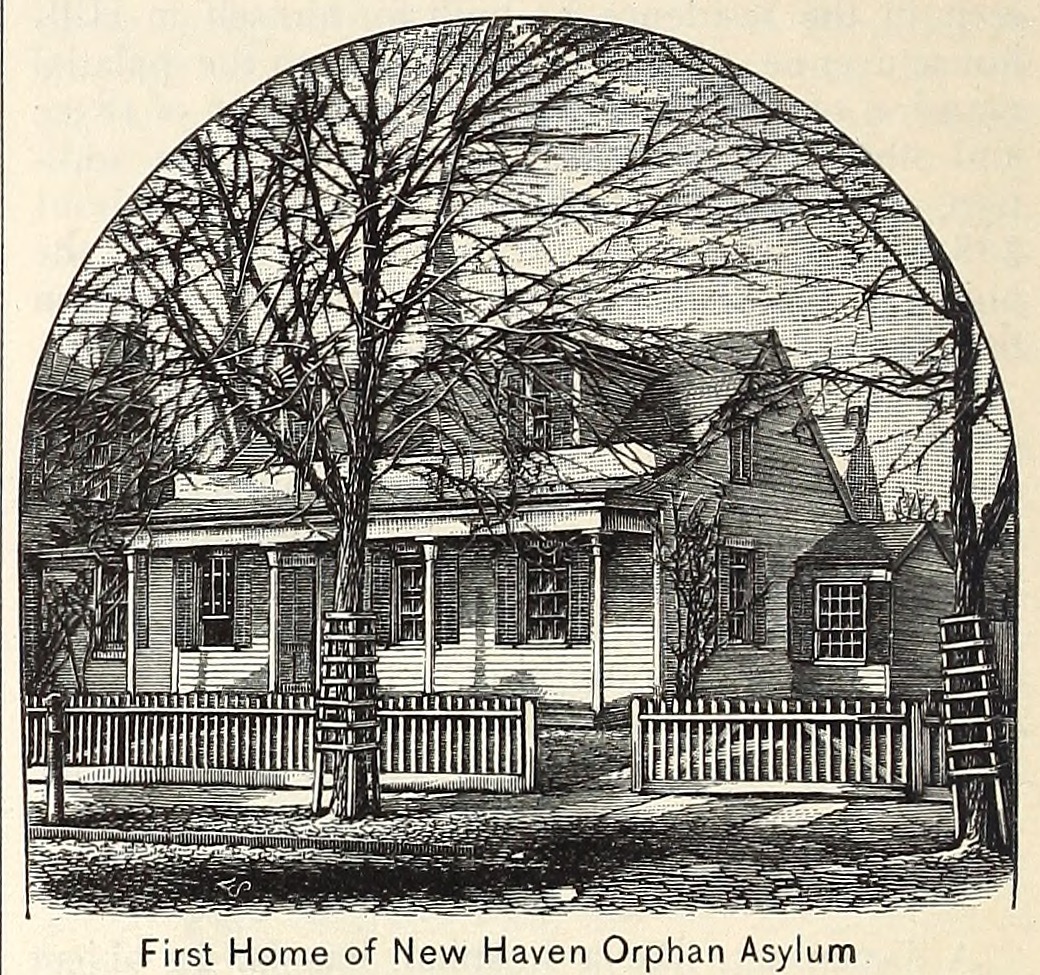
The asylum grew from a local response to the Daniells children, whose father had died of cholera and whose mother was dying. The 1883 anniversary history describes an organizing meeting on February 26, 1833, when women formed a society to help orphaned and destitute children. A small rented cottage on Grove Street became its first home. By the first week of May, the four siblings and three children from the almshouse were living there under matron Amelia Goodyear. [NH-006]
Growing numbers brought a move to Oak Street in 1838. The later asylum building was occupied in 1855. The history recounts donations, financial shortages and epidemics, showing how shelter, nursing, schooling and fundraising were bound together. Its writers also describe children who returned to a parent: the historical word “orphan” did not mean that every resident had lost both parents. [NH-006]
The institution’s anniversary account reports 46 deaths across its first fifty years. Another passage credits Mr. Heaton with a cemetery lot, but leaves the cemetery unnamed. These statements are starting points for recovering individual histories. They do not establish the children’s names, a complete burial total, or a particular cemetery. [NH-004]
The successor organization moved to Hamden in 1925 and is now The Children’s Center of Hamden. The archive keeps that institutional line distinct from St. Francis Orphan Asylum, represented here by a separate historical photograph and a library catalog link. [NH-007]
The Children’s Center of Hamden identifies the New Haven Orphan Asylum, founded in 1833, as its own beginning. This continuity is the reason to expand the existing asylum collection across two towns. The already archived New Haven premises, nineteenth-century mortality extracts and first-home illustration remain part of the same institutional history. [NH-007]
A federal population schedule adds a different kind of evidence to the institutional narrative. The selected 1880 crop is headed New Haven Orphan Asylum and contains an Owen Bray entry. Baldwin’s family research discusses Owen and Stephen Bray in the Elm Street institution. The record establishes residence at the census date; it does not establish that a child was parentless, when a child was admitted, or whether the child died or was buried there. [NH-012]
Plans for Hamden preceded the move by several years. Hill’s 1918 history records Frederick F. Brewster’s 1916 gift of land in Whitneyville and support for a $250,000 building fund. At publication the new buildings were delayed by wartime conditions. The passage also stresses the institution’s women founders and managers, allowing the relocation story to include organizational continuity as well as a benefactor and a site. [NH-011]
The Children’s Center’s own history dates the actual move to its Whitney Avenue campus in Hamden to 1925. This establishes the Hamden organization as the continuation of the New Haven Orphan Asylum rather than a separate collection with a new 1925 institutional founding date. Its current address is 1400 Whitney Avenue. A campus opening program, deed or contemporary photograph would add detail that the present short institutional history does not supply. [NH-007]
A July 2020 New Haven Independent report provides an intermediate snapshot of the Hamden institution’s later work. It describes special education, youth residential treatment and family programs, as well as the Casa Rios program for women. These services show how far the organization’s role had developed beyond its nineteenth-century asylum model; the article documents its particular reporting date rather than a permanent program roster. [NH-014]
The present Children’s Center describes a continuum of behavioral health, psychiatric, educational and family support services for youth across Connecticut. Its own account dates the Whitney Avenue relocation to 1925 and presents that move within a continuous history from 1833. The campus chapter can therefore be added without assigning a new founding date or treating the successor name as a separate orphanage. [NH-007]
The Daniells children give the asylum’s founding a human scale: an organization emerged from a particular family crisis, then expanded through rented and purpose-built premises. The women who organized and managed the society belong in the relocation story as much as the later land donor. A census entry can place a child inside the institution on a particular day, while an anniversary history explains how administrators wished to remember its work. Neither establishes every child’s circumstances. Following the move from New Haven to Hamden therefore means tracking a continuing organization across changing buildings, names and services, while keeping children’s individual histories distinct from the institution’s own account of progress. [NH-006] [NH-004] [NH-007]