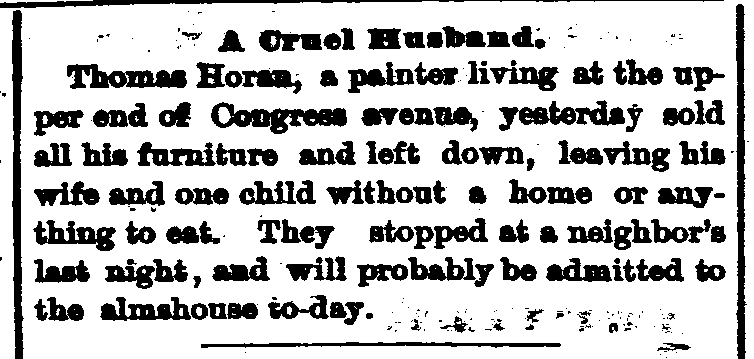
A Cruel Husband — Horan household newspaper notice · 1885-09-23 (date supplied by reproducing researcher)
OPENING / FIRST RECORDED DATE1884 (Blake Street); 1927 (Woodin Street)
FOUNDED / HISTORICAL PERIOD1884 (Blake Street); 1927 (Woodin Street)
The dates describe two distinct cemeteries. Reported operating periods overlap: Blake Street 1884–1931 and Woodin Street 1927–1985. Do not treat Woodin as a Hamden cemetery solely because it adjoins the town border.
LOOK CLOSER · OPEN ANY IMAGE
The story in photographs
1 images
1885-09-23 (date supplied by reproducing researcher)
A household before a numbered grave
The short Horan notice is a glimpse of housing loss and anticipated poor relief in 1885. Its language reflects a newspaper’s account, and its crop omits the masthead. Anna’s later identification at Blake Street rests on separate research and numbered burial evidence. Keep the family story connected without turning this article into an admission record or cemetery register.
Image credit & source
New Haven Morning Journal and Courier, historical clipping reproduced by Sherill Baldwin, Buried Stories
Read the full story of New Haven Municipal Burial Grounds
COLLECTION HISTORY
The people behind the place.
The familiar label “New Haven paupers cemetery” covers more than one place. Blake Street is the hillside municipal ground behind the Westville and Mishkan Israel cemeteries. Woodin Street is a separate city burial ground near the Hamden boundary. Researcher Sherill Baldwin lists both independently and separately records an almshouse burial ground whose location remains unresolved. Keeping these places distinct is essential when matching an institutional death to a cemetery record. [PAU-009]
Blake Street served poor and unclaimed burials from 1884 to 1931, according to John Moritz’s 2026 reporting, which describes roughly 2,200 people buried there. Most markers used numbers rather than names. These approximate totals and operating dates are reported historical findings, not a count independently established from a complete register in this collection. [PAU-010]
Names can survive even where the stones have lost their numbers. Baldwin’s Blake Street project starts with material from the Charles R. Hale Collection and presents modern rearrangements by surname, age, death year and plot number. These are finding aids derived from an earlier compilation. The source record, the modern transcription and a field identification of a particular stone each answer different questions and should be checked against one another. [PAU-003]
Woodin Street’s separate chronology is documented in a 2019 report based on interviews with city staff. The approximately two-acre ground opened in 1927 and received its last burial in 1985; staff reported 1,101 burials and described a surviving names-to-numbers record book. Anna Fitch Ardenghi’s 1954 trust funded cemetery improvements, including a fence and granite cross. The 2019 project sought to repair the grounds and recover sunken markers; its announcement is not evidence that every proposed repair was completed. [PAU-004]
Anna Horan’s recovery illustrates how a life history and a gravesite identification require different evidence. An 1885 newspaper notice describes a Horan household crisis and a possible almshouse admission. Baldwin’s later research connects Anna’s 1907 death with Blake Street number 685 and explains how neighboring numbered entries helped locate the weathered marker. Descendants subsequently supplied a named stone. The notice alone neither names Anna nor establishes where she was eventually buried. [PAU-001]
Recent remembrance also includes the Tritton family. Trinity on the Green and St. Luke’s announced a June 14, 2026 memorial dedication for Lucy Tritton, Lois Tritton and descendants at the Westville cemetery grounds. The dedication and family names document commemorative work; a shared memorial inscription should not by itself be used to infer that every person named occupies the same grave. Original freedom papers, cemetery entries and vital records remain separate sources for each person’s history. [PAU-011]
Numbered markers made a record book essential to identifying graves. The recovery stories show how a transcription, neighboring numbers, family research and field observation can work together, while none is sufficient alone. Blake Street and Woodin Street must remain separate because their periods of use and surviving records differ. Modern memorials restore public attention, but an inscription on a shared monument does not prove that everyone named lies beneath it. Teaching this history means keeping people at the center: municipal poverty categories describe an administrative system, not the full lives of those buried. A recovered name can begin a biography through family, work, church and neighborhood records. [PAU-009] [PAU-010] [PAU-003]
The dates describe two distinct cemeteries. Reported operating periods overlap: Blake Street 1884–1931 and Woodin Street 1927–1985. Do not treat Woodin as a Hamden cemetery solely because it adjoins the town border.
About this research edition. Identity, burial-record leads, numbered markers and selected family documentation. Blake Street is behind Westville Cemetery and Congregation Mishkan Israel’s cemetery, accessible through the 661 Whalley Avenue cemetery tract. Woodin Street is by Rockview at the base of Mueller Drive near the Hamden border. The earlier almshouse burial ground has not been located by the cited researcher and is not equated with either site. No complete original burial register or rights-cleared historic photograph of these grounds was acquired.
THE SEARCHABLE CATALOG
Images, maps & original records
Search includes catalog notes and the OCR text included with this edition. OCR may misread names or dates; use the original scan to verify a match.
A contemporary notice reports that Thomas Horan left his wife and one child without furniture, food or a home, and anticipates an almshouse admission. It supplies family circumstances, not a burial record.
A 2019 view of a visible grave in the former municipal burial ground. The article's condition report describes 2019, not necessarily the cemetery today.
Extract the ZIP and open START_HERE.html. It includes the catalog, selected images, acquired source text, credits and a searchable SQLite database. New photo additions are hosted in the SGC media library and require an internet connection; original bundled images remain available offline.