Read the full story of Historic Churches of New Haven and West Haven
COLLECTION HISTORY
The people behind the place.
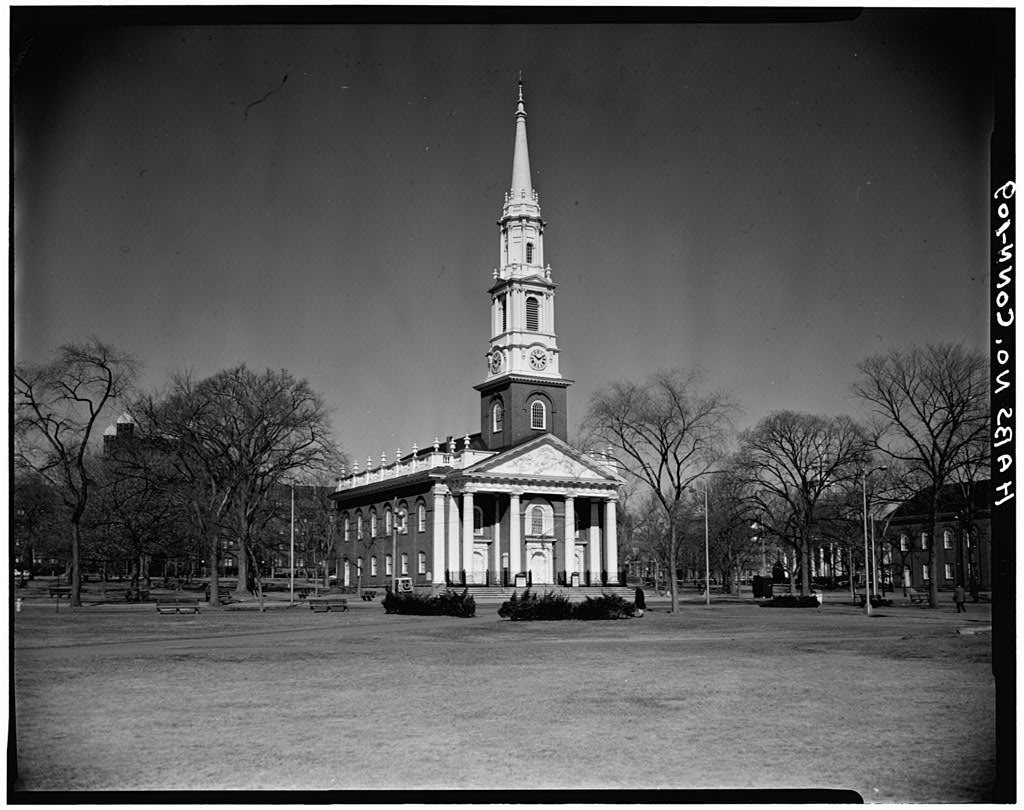
New Haven’s three Green churches were built within a short period: Center in 1812–1814, United in 1813–1815 and Trinity in 1814–1816. Their alignment along Temple Street places Federal architecture beside an early Gothic church. The National Register account discusses changing design attributions as well as the buildings’ exterior forms. It is a useful corrective to a directory that would reduce each church to a single architect’s name without distinguishing initial plans, revisions and execution. [NHCH-021]
Center Church’s congregation was organized in 1639, but its present meeting house is the fourth. Built over part of the ancient burial ground, it preserves graves beneath a later sanctuary. The 1967 HABS exterior and the 2025 crypt view therefore describe different historical layers of the same site. The church’s own history dates the surviving crypt gravestones from 1687 to 1812; the cemetery material should not be confused with evidence that this building itself dates to the seventeenth century. [NHCH-007]
West Haven’s First Congregational Church began in 1719 after local residents sought a place to worship closer to home. Its original sanctuary was followed by an 1851 replacement, destroyed by fire in 1857. The present sanctuary was built in 1859. The modern photograph included here records that third building, while the institution’s earliest records belong to the earlier community and its previous places of worship. A congregation’s continuous identity can thus span quite different physical structures. [NHCH-017]
Across Church Street in West Haven, Christ Episcopal Church presents another long parish history in a later building. The parish dates to 1723; its first church edifice was built in 1739. Bertram Grosvenor Goodhue designed the present church, consecrated in 1907, with traprock facing over concrete. Its associated parish house followed in the next decade. The district nomination inventories church, parish house and cemetery separately, providing a model for distinguishing their overlapping but nonidentical dates. [NHCH-018]
St. Luke’s on Whalley Avenue reflects Black institution-building within New Haven’s Episcopal community. The congregation organized in 1844 after separation from Trinity and later purchased a Park Street church. A building campaign begun in 1894 led to the 1905 church designed by Brown & von Beren. The nomination connects that architecture with fundraising and community history, rather than treating the Gothic exterior as the whole story of the institution. [NHCH-011]
A congregation’s organization date and a church building’s construction date should remain distinct. Congregations can move, replace buildings or change names, while an older building may acquire another use. Photographs therefore need the exact congregation, structure and date identified by the source. The churches also connect with schools, charitable work, family ceremonies and burial records, allowing their histories to extend beyond architecture. Those connections must be established through specific records rather than inferred from denomination alone. Comparing several congregations can reveal different neighborhood roles while keeping each institution’s identity and documentary limits intact. [NHCH-021] [NHCH-007] [NHCH-017]
ESTABLISHEDMultiple congregations; see institution profiles
EARLIEST HISTORYMultiple buildings; see institution profiles
Congregation dates and building dates are recorded separately. Similar names—Center Church, Christ Church New Haven and Christ Episcopal Church West Haven—refer to different institutions.
About this research edition. Acquired: four reused and rechecked church photographs/plates (Center exterior 1967, Center crypt 2025, West Haven First 2013, St. Mary’s published 1900), plus North Church’s 1867 manual title page and Center Church’s 1914 catalogue title page. Institution profiles in leads cover additional buildings in both towns; those do not imply a local image was acquired. Existing church-burial-records remains the record-search collection.


.jpg)

