Read the full story of Strong School, New Haven
COLLECTION HISTORY
The people behind the place.
The local school lineage begins in 1808, when Nathaniel Graniss provided land for a school. The building changed function over time: a church used it from 1830, leaving classrooms in the basement, and the school again occupied the whole structure after the church moved in 1864. This early history belongs to a predecessor, not the surviving Tudor building. [NHSS-005]
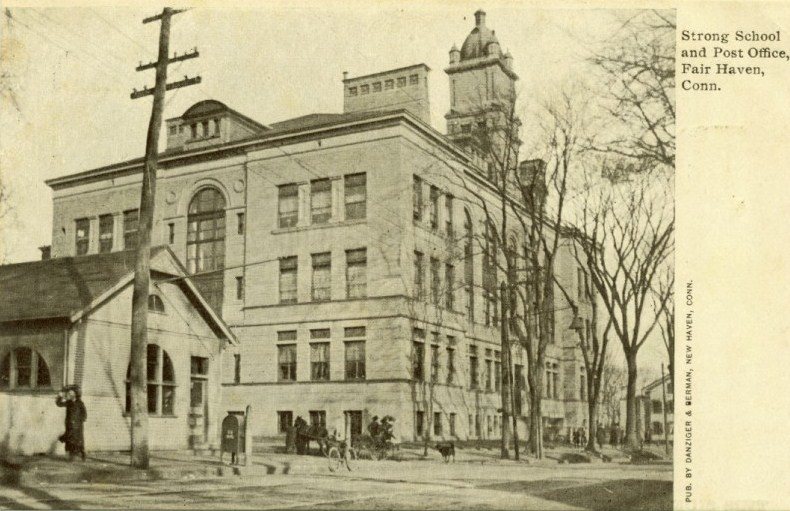
The predecessor carried the Woolsey name before a separate Woolsey School opened in 1873. It then became Grand Street School or Fair Haven School. An 1895 replacement honored Horace H. Strong, a Fair Haven warden and education-board member; fire destroyed it on January 27, 1914. [NHSS-005]
The surviving postcards make that lost building tangible. One advertises the school together with the U.S. Post Office. The other was postmarked in 1915, after the fire: a reminder that a postcard’s mailing date can preserve a view that was already out of date. Neither depicts the low, spreading replacement. [NHSS-001]
The architectural teaching unit prepared for the Yale–New Haven Teachers Institute describes the replacement at Grand and Clinton as an unusually elaborate school of the period after 1915. Its Collegiate Tudor vocabulary includes brick walls relieved by diamond-pattern decoration, extensive windows and twin towers. The school occupies the crest of Grand Avenue before the street descends toward the river. This hilltop position and broad facade gave a neighborhood public institution considerable visual presence; the author contrasted schools’ lateral reach with the upward emphasis of nearby churches. [NHSS-004]
In the February 2025 State of the City address, New Haven’s mayor named the old Strong School among sites in the housing-development pipeline. That statement is useful as a dated record of public plans. It does not establish a completion date or prove that a proposed conversion had opened. [NHSS-006]
A predecessor date and the date a school received its familiar name describe different kinds of continuity. Strong’s history should follow the institution, its premises and the community it served without assuming that a later building was present at the beginning. Photographs of pupils or a school event can broaden the architectural story, but their captions must establish the group and year. Municipal reports and school records explain decisions about organization and facilities; recollections can reveal how those decisions were experienced. Bringing them together preserves both the public institution and the daily educational life that a facade alone cannot represent. [NHSS-005] [NHSS-001] [NHSS-004]
ESTABLISHED1808 (predecessor school); Strong name from 1895
EARLIEST HISTORY1915 (replacement building; exact opening day not established)
The 1808 date belongs to the local school lineage. The 1895 building burned in January 1914; the surviving Tudor replacement is generally dated 1915. A postcard postmarked 1915 still shows the destroyed building.
About this research edition. Acquired: two public-domain postcards of the pre-1914 building and one public-domain October 2010 photograph of the Tudor replacement. Historic address: 69 Grand Avenue at Clinton Avenue, Fair Haven, New Haven. External leads provide architectural history and later reuse context. The program’s subsequent locations are not illustrated here.