Health and public institutions · photographs, documents & local history
Newington’s state tuberculosis institution and its later psychiatric role, documented through original state reports, campus recreation photographs and archival leads.
Cedarcrest in August 2010 · August 13, 2010. Josh Michtom, Flickr; CC BY-NC-SA 2.0. Reproduced for this noncommercial nonprofit archive under the same license.
OPENING / FIRST RECORDED DATE1910
FOUNDED / HISTORICAL PERIOD1910
The 1924–1926 State Tuberculosis Commission report explicitly gives 1910 as the opening year; an exact opening day was not found. The same report dates the general change from county-home names to state-sanatorium names to 1913. Cedarcrest was in use as the distinctive name by 1926; this research does not assign an unsupported exact naming day.
LOOK CLOSER · OPEN ANY IMAGE
The story in photographs
7 images
August 13, 2010
Cedarcrest in August 2010
A surviving Cedarcrest building photographed in Newington in August 2010. The image records the campus in its later hospital era, a century after the tuberculosis institution opened.
Image credit & source
Josh Michtom, Flickr; CC BY-NC-SA 2.0. Reproduced for this noncommercial nonprofit archive under the same license.
The state report calls this scene “The Medalist at Cedarcrest.” Croquet, trees and a shingled building are visible; the women are unnamed and the photograph is undated. Its 1926 publication is the secure date.
Image credit & source
Connecticut State Tuberculosis Commission, Report for July 1, 1924–June 30, 1926; University of Toronto copy digitized by Internet Archive.
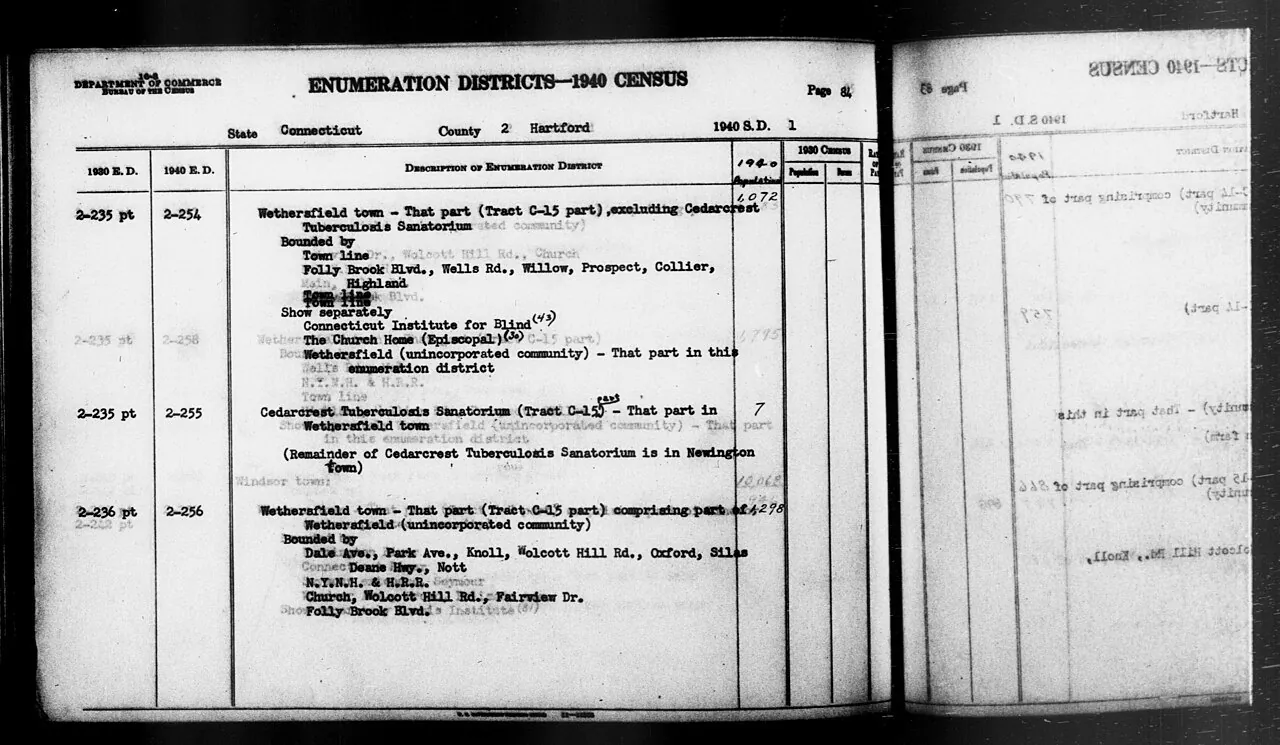
1940 census; catalog's 1850–1950 range is the series range
Cedarcrest in the 1940 census district descriptions
1940 census enumeration-district description naming Cedarcrest Tuberculosis Sanatorium. District 2-255 identifies part of Cedarcrest Tuberculosis Sanatorium in Wethersfield. This administrative description helps locate the institution across municipal boundaries.
Image credit & source
U.S. Census Bureau / National Archives and Records Administration, via Wikimedia Commons
The commission’s narrative describes the earlier county-home plan, a 1913 naming change, and the subsequent adoption of Cedarcrest as a distinctive institutional name.
Image credit & source
Connecticut State Tuberculosis Commission, Report for July 1, 1924–June 30, 1926, printed p. 16; Internet Archive.
Cedarcrest depended on cooks, orderlies, maintenance staff and laundry workers as well as clinicians. The 1926 report describes a central laundry serving three sanatoria, making an apparently local campus part of a larger state system.
Image credit & source
Connecticut State Tuberculosis Commission, Report for July 1, 1924–June 30, 1926, printed p. 17; Internet Archive.
A heating project became an opportunity to move roads and bury wires. The commission’s 1928 account connects the campus’s appearance with its practical infrastructure and a proposed new infirmary.
Image credit & source
Connecticut State Tuberculosis Commission, Report for July 1, 1926–June 30, 1928, printed p. 9; Internet Archive.
Tom Kirsch’s photographs of Cedarcrest’s older pavilion show wards, balconies, corridors and surviving hospital details in November 2005. Open the complete 22-image gallery at Opacity.
Cedarcrest began as a tuberculosis institution in 1910. The State Tuberculosis Commission’s 1924–1926 report states the opening year and recalls its original long title, Hartford County Home for the Care and Treatment of Persons Suffering from Tuberculosis. Although “Hartford” appeared in institutional names, the campus was in Newington. The exact opening day has not been established from the material assembled here. [CEDARCREST-012]
The early county-home plan did not develop as intended. The commission explained that county authorities were unenthusiastic and the state assumed the expense. Its account dates the renaming of the institutions as state sanatoria to the General Assembly of 1913. Distinctive names followed for what the report called psychological reasons; by the time this report was published in 1926, the Hartford institution was called Cedarcrest. [CEDARCREST-003]
The report also reveals the labor behind daily care. Head nurse Anna M. Walsh supervised sixteen ward nurses and eight orderlies, while kitchen, grounds, engineering and night-watch staff kept the institution running. Some former patients provided part-time services as laboratory technicians or nurses. Cedarcrest’s central laundry served three state sanatoria west of the Connecticut River, extending the campus’s work beyond its own wards. [CEDARCREST-004]
Two photographs published with the 1926 report show outdoor recreation beside campus buildings and trees. One depicts a woman playing croquet; the other shows a group gathered around a table for cards. The report’s captions name Cedarcrest but do not identify the people or say when the photographs were taken. These images therefore document represented campus life without allowing individual medical histories to be inferred. [CEDARCREST-001]
The 1926–1928 report locates Cedarcrest in Newington, about a mile from the Hartford line, and records accommodations for 192 patients. A central heating project prompted the rearrangement of roads and burial of utility wires in steam conduits. Officials described the existing buildings as inexpensive wooden structures and proposed a fireproof combined infirmary and administration building. They also reported moving a cottage from the Balf farm onto the grounds for a resident physician. [CEDARCREST-005]
Cedarcrest later changed purpose. The secondary institutional history assembled by Asylum Projects dates the end of tuberculosis and chronic-disease operations and the transfer to mental-health care to February 1976. For the later closure, this archive now follows the more precise state records cited below: administrative consolidation in 2010 and psychiatric inpatient termination on January 6, 2011. [CEDARCREST-010] [CEDARCREST-2026-B]
Later psychiatric services gave Cedarcrest another role after its tuberculosis era. The final transition happened in stages: DMHAS places the consolidation of Cedarcrest services with Connecticut Valley Hospital in 2010, while the General Assembly records January 6, 2011 as the termination of psychiatric inpatient services under a settlement agreement. These sources distinguish an administrative change from the end of inpatient care. The campus photographs preserve another part of that history: buildings, open grounds and the older pavilion, seen at different moments rather than one universal closure date. [CEDARCREST-2026-A] [CEDARCREST-2026-B]
ESTABLISHED1910
EARLIEST HISTORY1910
The 1924–1926 State Tuberculosis Commission report explicitly gives 1910 as the opening year; an exact opening day was not found. The same report dates the general change from county-home names to state-sanatorium names to 1913. Cedarcrest was in use as the distinctive name by 1926; this research does not assign an unsupported exact naming day.
About this research edition. Cedarcrest in Newington, formerly a state tuberculosis sanatorium and later a mental-health hospital. Early photographs and documents are public-domain publication scans. Later psychiatric history is summarized with attribution; protected modern photographs are provided only as links.
THE SEARCHABLE CATALOG
Images, maps & original records
Search includes catalog notes and the OCR text included with this edition. OCR may misread names or dates; use the original scan to verify a match.
The commission’s narrative describes the earlier county-home plan, a 1913 naming change, and the subsequent adoption of Cedarcrest as a distinctive institutional name.
The report identifies Cedarcrest’s Newington location and 192-bed capacity, then describes road and utility alterations, wooden buildings, a proposed fireproof infirmary and a relocated farm cottage.
1940 census enumeration-district description naming Cedarcrest Tuberculosis Sanatorium. District 2-255 identifies part of Cedarcrest Tuberculosis Sanatorium in Wethersfield. This administrative description helps locate the institution across municipal boundaries.
A surviving Cedarcrest building photographed in Newington in August 2010. The image records the campus in its later hospital era, a century after the tuberculosis institution opened.
Tom Kirsch’s photographs of Cedarcrest’s older pavilion show wards, balconies, corridors and surviving hospital details in November 2005. Open the complete 22-image gallery at Opacity.
Extract the ZIP and open START_HERE.html. It includes the catalog, selected images, acquired source text, credits and a searchable SQLite database. New photo additions are hosted in the SGC media library and require an internet connection; original bundled images remain available offline.