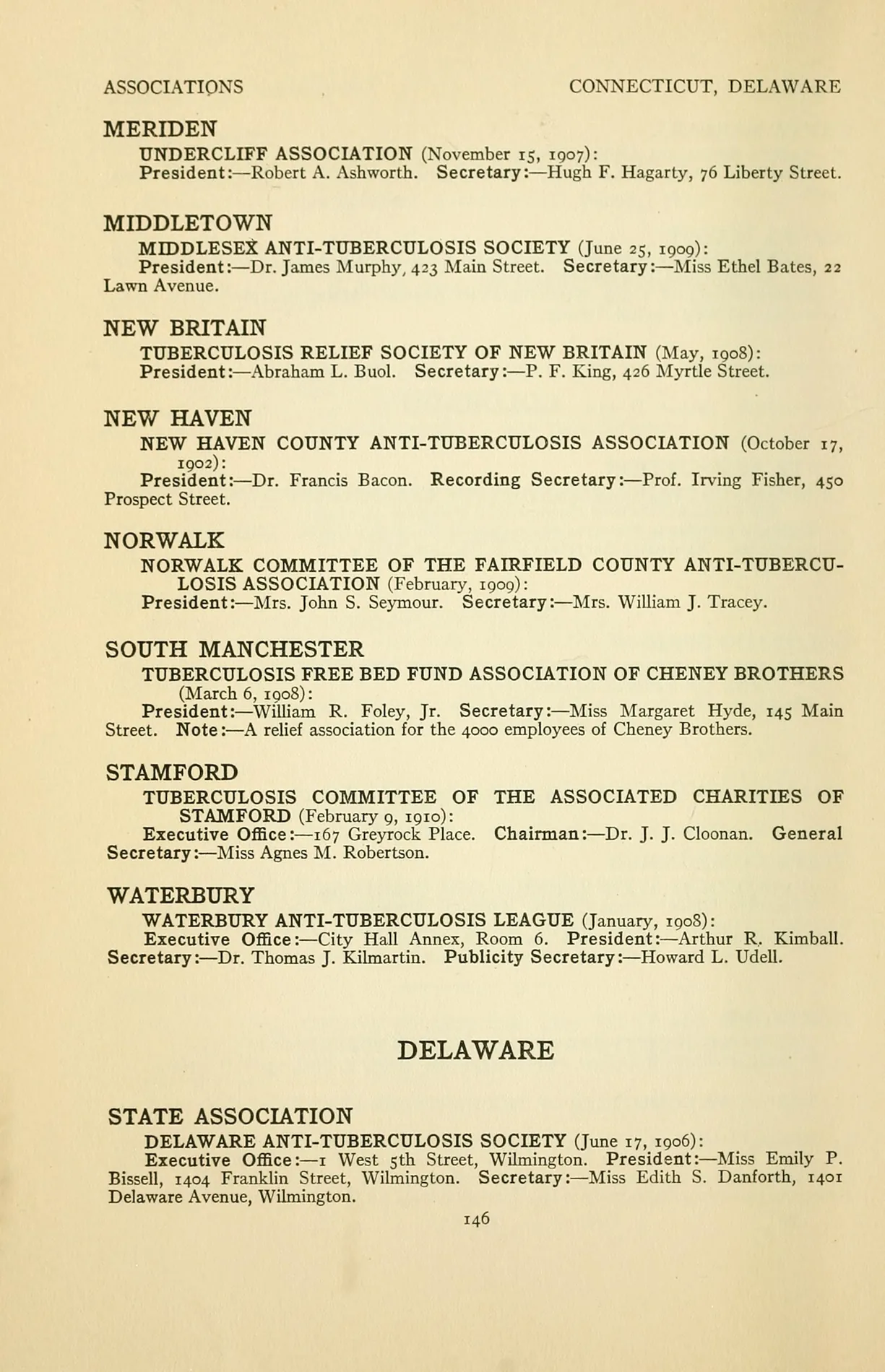
OPENING / FIRST RECORDED DATEUndercliff Association: November 15, 1907
FOUNDED / HISTORICAL PERIODState sanatorium: January 1, 1910
The association’s date is distinct from the state sanatorium opening. The 1911 directory supplies the opening date; later psychiatric, developmental-services and closure dates remain under research.
LOOK CLOSER · OPEN ANY IMAGE
The story in photographs
12 images
1914
A building designed around care
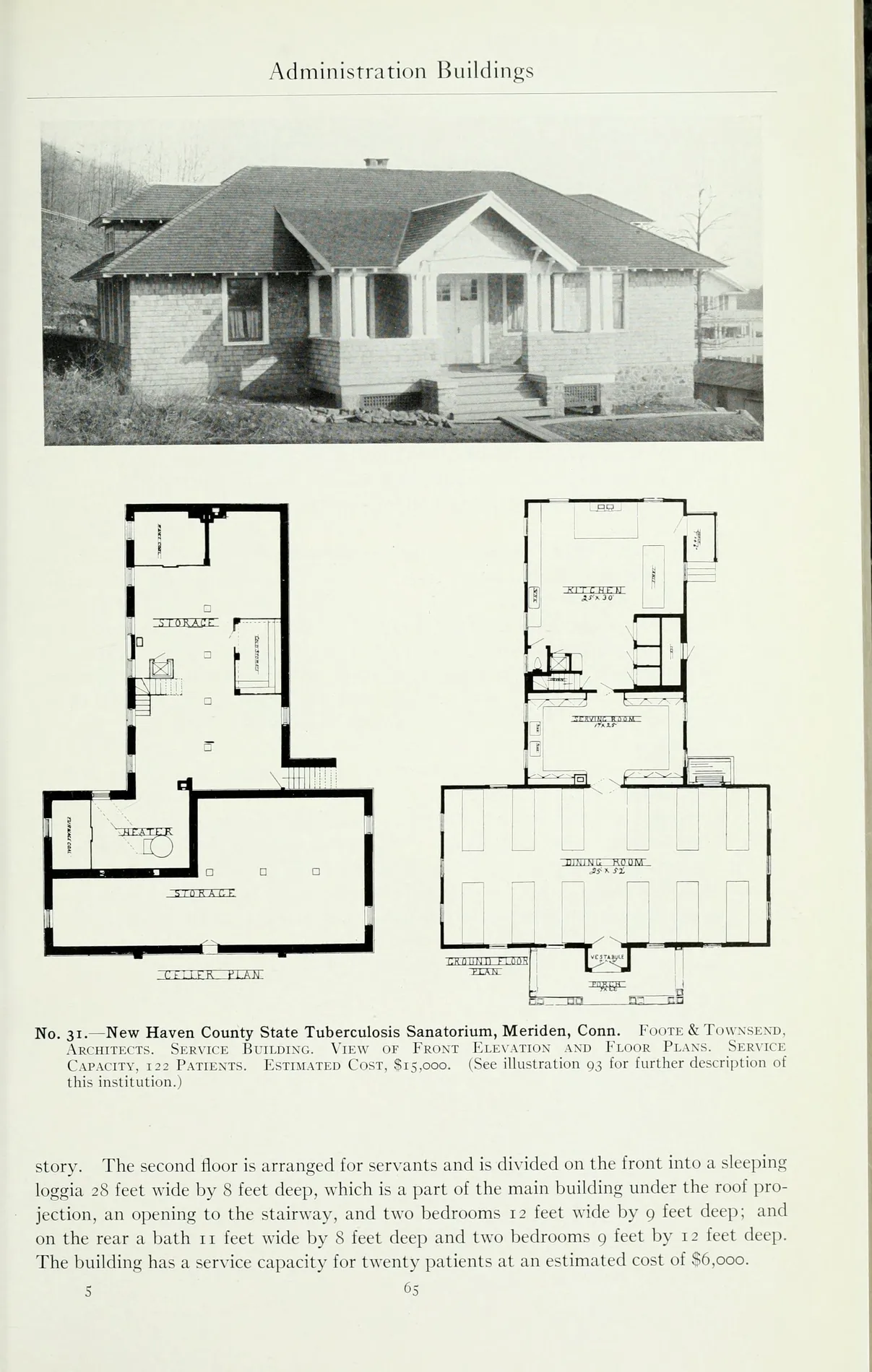
A photograph and floor plans share one page. Follow the labeled service rooms before comparing the building’s exterior. The manual makes architecture part of the institutional record, while the original caption identifies the Meriden project.
Image credit & source
Thomas Spees Carrington; National Association for the Study and Prevention of Tuberculosis, Tuberculosis Hospital and Sanatorium Construction, third edition (1914), p. 65; University of California Libraries / Internet Archive. Public domain in the United States.
Two-story open-air ward building at the New Haven County State Sanatorium in Meriden, credited to Foote & Townsend. Plan I belongs to Meriden. Plan II is explicitly a comparison for Huntington, Connecticut; it must not be labeled as Undercliff. Photograph date unknown; published in 1914.
Image credit & source
Thomas Spees Carrington; National Association for the Study and Prevention of Tuberculosis, Tuberculosis Hospital and Sanatorium Construction, third edition (1914), p. 150; University of California Libraries / Internet Archive. Public domain in the United States.
Two photographs preserve an Undercliff winter hike in a report published in 1924. The group is not individually identified. The images offer a glimpse of organized outdoor activity, but cannot establish the experience or medical history of any particular person.
Image credit & source
Connecticut State Tuberculosis Commission, Report of the State Tuberculosis Commission, July 1, 1922–June 30, 1924 (1924), p. unnumbered plate facing page 24; Gerstein Science Information Centre, University of Toronto / Internet Archive. Public domain in the United States.
The national tuberculosis directory lists the New Haven County State Tuberculosis Sanatorium at Meriden with the date January 1, 1910, capacity 122, and superintendent Dr. J. B. Dinnan. Its introductory note explains that parenthetical dates ordinarily indicate opening dates.
Image credit & source
Philip P. Jacobs, compiler; National Association for the Study and Prevention of Tuberculosis, A Tuberculosis Directory (1911), p. 19; Columbia University Libraries / Internet Archive. Public domain in the United States.
The 1911 national directory lists the Undercliff Association at Meriden with the date November 15, 1907. This is evidence for an anti-tuberculosis association; it does not establish that the state sanatorium opened in 1907.
Image credit & source
Philip P. Jacobs, compiler; National Association for the Study and Prevention of Tuberculosis, A Tuberculosis Directory (1911), p. 146; Columbia University Libraries / Internet Archive. Public domain in the United States.
The commission explains its decision to make the Meriden sanatorium a children-only institution. The page also contains superseded early-twentieth-century theories of tuberculosis; reproduce as a historical document, not medical advice.
Image credit & source
Connecticut State Tuberculosis Commission, Report of the State Tuberculosis Commission, October 1, 1918–June 30, 1920 (1920), p. 11; Gerstein Science Information Centre, University of Toronto / Internet Archive. Public domain in the United States.
Continuation of the policy discussion: children with pulmonary tuberculosis were to go to Meriden, while bone and glandular cases were to go to Seaside at Niantic. The commission says the change required revised building plans.
Image credit & source
Connecticut State Tuberculosis Commission, Report of the State Tuberculosis Commission, October 1, 1918–June 30, 1920 (1920), p. 12; Gerstein Science Information Centre, University of Toronto / Internet Archive. Public domain in the United States.
The report describes Meriden’s wooded hillside location and white buildings, records Dr. Cole B. Gibson’s succession to Dr. Dinnan, and discusses the need for recreation space.
Image credit & source
Connecticut State Tuberculosis Commission, Report of the State Tuberculosis Commission, October 1, 1918–June 30, 1920 (1920), p. 19; Gerstein Science Information Centre, University of Toronto / Internet Archive. Public domain in the United States.
The Meriden section requests a separate assembly space that could also serve as a school, a playground, and equipment for an authorized children’s building. The lower half moves on to Norwich and Shelton; those sections are not Undercliff.
Image credit & source
Connecticut State Tuberculosis Commission, Report of the State Tuberculosis Commission, October 1, 1918–June 30, 1920 (1920), p. 20; Gerstein Science Information Centre, University of Toronto / Internet Archive. Public domain in the United States.
The report records four teachers at Undercliff in 1924. Read this page beside the earlier request for an assembly room and playground to follow the practical demands of a children’s institution.
Image credit & source
Connecticut State Tuberculosis Commission, Report of the State Tuberculosis Commission, July 1, 1922–June 30, 1924 (1924), p. 14; Gerstein Science Information Centre, University of Toronto / Internet Archive. Public domain in the United States.
The 1928 report traces the infirmary from stagecoach road house to Meriden almshouse and state tuberculosis facility. It describes earlier adult use, dates the children-only conversion to 1918, and lists a 220-bed institution in the reporting period.
Image credit & source
Connecticut State Tuberculosis Commission, Report of the State Tuberculosis Commission, July 1, 1926–June 30, 1928 (1928), p. 8; Gerstein Science Information Centre, University of Toronto / Internet Archive. Public domain in the United States.
The Undercliff passage at the top asks legislators to replace the aging infirmary with a fireproof brick or stone building. This documents a request, not the completion date of the later hospital. The remaining page concerns Cedarcrest in Newington.
Image credit & source
Connecticut State Tuberculosis Commission, Report of the State Tuberculosis Commission, July 1, 1926–June 30, 1928 (1928), p. 9; Gerstein Science Information Centre, University of Toronto / Internet Archive. Public domain in the United States.
Undercliff’s early story begins with two different entries in a 1911 national directory: the Undercliff Association, dated November 15, 1907, and the state tuberculosis sanatorium at Meriden, dated January 1, 1910. The latter lists 122 beds and superintendent Dr. J. B. Dinnan. Keeping the association and state institution distinct avoids assigning one opening date to both. [UC-004]
By 1914, an architectural manual illustrated the Meriden service building and open-air wards. Foote & Townsend are credited as architects. The photographs sit beside floor plans, showing how circulation, service rooms and ward design were presented to readers planning tuberculosis facilities. One comparison plan belongs to Huntington, not Meriden. [UC-002]
The 1918–1920 commission report describes a change toward children with pulmonary tuberculosis and the resulting building and educational needs. A 1928 retrospective dates the conversion to 1918 and explicitly recalls earlier adult patients. These sources do not support the often repeated claim that adults first entered in 1939. [UC-006]
The old infirmary had already served as a stagecoach road house and Meriden almshouse before state use, according to the 1928 report. That report requests a replacement building. A request is evidence of a proposal; completion, later service changes and final campus closure require further records. [UC-011]
Open-air wards and service buildings place the treatment approach within a designed environment. The 1914 architectural publication connects images with floor plans, showing how planners represented circulation and support work. It is evidence of design and presentation, not a complete account of patients’ lives. The later shift toward children with pulmonary tuberculosis added educational needs to the campus story. Because the reports recall earlier adult patients, the chronology cannot begin adult care in 1939. The older infirmary’s previous uses as road house and almshouse add another layer of institutional reuse. Proposals for replacement buildings remain proposals until completion records are located, keeping architectural ambition separate from what was actually built. [UC-004] [UC-002] [UC-006]
ESTABLISHEDState sanatorium: January 1, 1910
EARLIEST HISTORYUndercliff Association: November 15, 1907
The association’s date is distinct from the state sanatorium opening. The 1911 directory supplies the opening date; later psychiatric, developmental-services and closure dates remain under research.
About this research edition. Twelve selected source plates published in 1911–1928, with searchable page OCR. Four historical photographs appear across three plates, including architectural plans and an outing. Reports document earlier adult tuberculosis care and the 1918–1920 transition to children’s care. This is not a patient register or a collection of original death certificates. Modern photographs and later records are linked where available.
THE SEARCHABLE CATALOG
Images, maps & original records
Search includes catalog notes and the OCR text included with this edition. OCR may misread names or dates; use the original scan to verify a match.
Meriden State Tuberculosis Sanatorium · buildings, education & public reports
The early Meriden sanatorium service building, with cellar and first-floor plans. The plate credits architects Foote & Townsend and gives a planned service capacity of 122 patients. Photograph date unknown; published in 1914. The text below the caption continues a discussion of a different institution.
Meriden State Tuberculosis Sanatorium · buildings, education & public reports
Two-story open-air ward building at the New Haven County State Sanatorium in Meriden, credited to Foote & Townsend. Plan I belongs to Meriden. Plan II is explicitly a comparison for Huntington, Connecticut; it must not be labeled as Undercliff. Photograph date unknown; published in 1914.
Meriden State Tuberculosis Sanatorium · buildings, education & public reports
Two period photographs show a group on a snowy hillside during an Undercliff outing. The published caption reads A Winter Hike at Undercliff. Individual names and exact camera dates are not supplied; the plate was published in 1924. These are public institutional illustrations, not patient case files.
Meriden State Tuberculosis Sanatorium · buildings, education & public reports
The national tuberculosis directory lists the New Haven County State Tuberculosis Sanatorium at Meriden with the date January 1, 1910, capacity 122, and superintendent Dr. J. B. Dinnan. Its introductory note explains that parenthetical dates ordinarily indicate opening dates.
Meriden State Tuberculosis Sanatorium · buildings, education & public reports
The 1911 national directory lists the Undercliff Association at Meriden with the date November 15, 1907. This is evidence for an anti-tuberculosis association; it does not establish that the state sanatorium opened in 1907.
Meriden State Tuberculosis Sanatorium · buildings, education & public reports
The commission explains its decision to make the Meriden sanatorium a children-only institution. The page also contains superseded early-twentieth-century theories of tuberculosis; reproduce as a historical document, not medical advice.
Meriden State Tuberculosis Sanatorium · buildings, education & public reports
Continuation of the policy discussion: children with pulmonary tuberculosis were to go to Meriden, while bone and glandular cases were to go to Seaside at Niantic. The commission says the change required revised building plans.
Meriden State Tuberculosis Sanatorium · buildings, education & public reports
The report describes Meriden’s wooded hillside location and white buildings, records Dr. Cole B. Gibson’s succession to Dr. Dinnan, and discusses the need for recreation space.
Meriden State Tuberculosis Sanatorium · buildings, education & public reports
The Meriden section requests a separate assembly space that could also serve as a school, a playground, and equipment for an authorized children’s building. The lower half moves on to Norwich and Shelton; those sections are not Undercliff.
Meriden State Tuberculosis Sanatorium · buildings, education & public reports
The 1928 report traces the infirmary from stagecoach road house to Meriden almshouse and state tuberculosis facility. It describes earlier adult use, dates the children-only conversion to 1918, and lists a 220-bed institution in the reporting period.
Meriden State Tuberculosis Sanatorium · buildings, education & public reports
The Undercliff passage at the top asks legislators to replace the aging infirmary with a fireproof brick or stone building. This documents a request, not the completion date of the later hospital. The remaining page concerns Cedarcrest in Newington.
Meriden State Tuberculosis Sanatorium · buildings, education & public reports
The published report uses Undercliff as the Meriden name, records a new fireproof reception building, and lists four teachers. The name’s first adoption date remains unverified.
Extract the ZIP and open START_HERE.html. It includes the catalog, selected images, acquired source text, credits and a searchable SQLite database. New photo additions are hosted in the SGC media library and require an internet connection; original bundled images remain available offline.